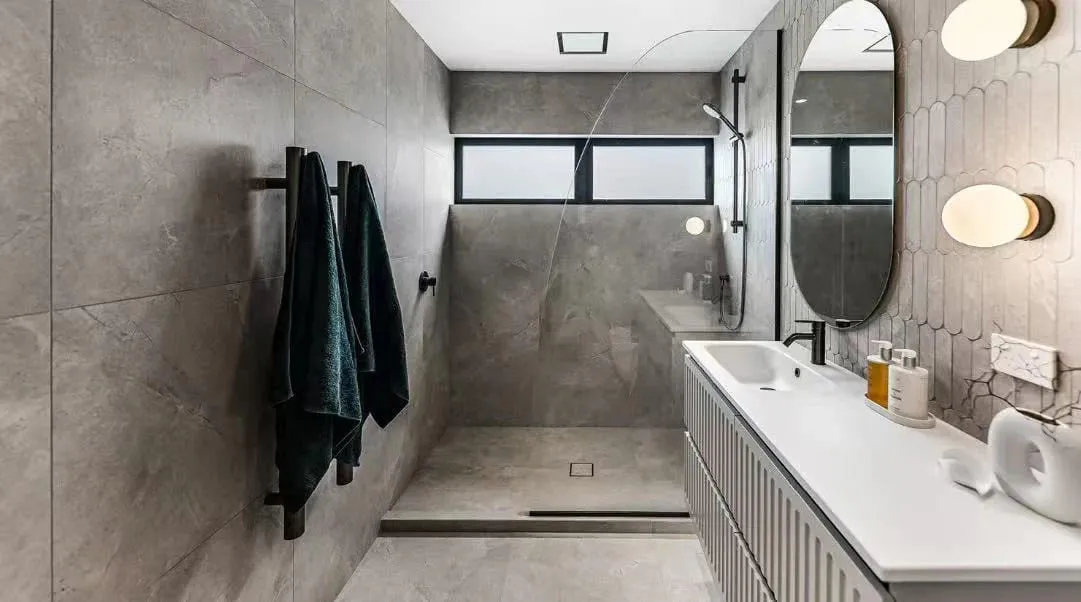

Bathroom tiling decisions feel straightforward until you're standing in a showroom with hundreds of options and no clear framework for narrowing them down. The challenge is that bathroom tiles are doing several different jobs simultaneously — waterproofing, slip resistance, visual coherence, ease of cleaning — and the right choice for each surface isn't always the same tile.
Here's how to think through each surface separately, and how to bring them together into a result that works.
Bathroom Floor Tiles: Where Slip Rating Is Non-Negotiable
The floor is the most safety-critical surface in a bathroom. When wet, a floor tile that looks beautiful can be genuinely dangerous if it doesn't have adequate slip resistance — and unlike most aesthetic mistakes, this one has real consequences.
Slip resistance in Australia is measured by the P-rating system. P3 is the minimum requirement for residential bathroom floors. P4 and P5 offer greater grip and are increasingly common in renovation specifications, particularly for households with older adults or young children.
The surface finish of a tile is the primary driver of its slip rating. Matt and textured finishes — including stone-look and concrete-look tiles with natural surface variation — generally achieve better P-ratings than polished or semi-polished surfaces. This doesn't mean polished tiles can't be used on bathroom floors, but it means checking the rating before purchasing rather than assuming.
Size matters on bathroom floors too. Large-format tiles — 600×600mm and above — have fewer grout lines, which makes cleaning easier and creates a cleaner visual result. They also require a very flat, well-prepared subfloor, which is worth factoring into the installation cost and timeline. Smaller tiles — mosaic formats in particular — provide more grout lines that offer natural grip, which is why mosaic floors remain popular in shower bases.
Porcelain tiles are the most common choice for bathroom floors in Melbourne renovations. Dense, low-absorption, and durable, they handle the sustained moisture exposure of a bathroom floor better than ceramic tiles, which are more porous and less suited to the constant wet conditions of a bathroom floor.
Bathroom Wall Tiles: Where Visual Impact Lives
The walls are where most of the bathroom's character comes from, and where the widest range of tile choices are genuinely appropriate. Wall tiles don't need a slip rating, they don't carry foot traffic, and they're protected from most of the moisture that affects the floor. This opens up more options.
Size and proportion. Tall, narrow tiles — 300×600mm portrait orientation, or 300×900mm — emphasise ceiling height and suit narrow bathrooms by drawing the eye upward. Wider formats and horizontal orientations make a room feel broader. In a small Melbourne bathroom, understanding how the tile format interacts with the room dimensions is as important as the tile itself.
Finish. A gloss or semi-gloss finish on wall tiles reflects light, which opens up smaller bathrooms. Matt wall tiles absorb light and create a softer, more textural result. In a bathroom with limited natural light — common in Melbourne's terrace houses and apartments — gloss wall tiles can make a meaningful difference to how bright the space feels.
Feature wall or full coverage. Using the same tile on all four walls is a cohesive approach, but it can feel heavy in a small bathroom. A common approach in Melbourne renovations is to tile the shower enclosure in a feature or textured tile — a stone look, marble look, or mosaic — and use a simpler, complementary tile on the remaining walls. This creates visual interest without the budget of tiling every surface in a premium product.
Subway tiles remain one of the most consistently requested wall tile formats for Melbourne bathrooms, and for good reason — they're versatile, they suit a range of interior styles from period homes to contemporary apartments, and they're available across a wide price range. The variation in grout colour and tile format (standard 75×150mm through to larger brick formats) allows significant customisation within a familiar pattern.
Shower Tiles: Where Both Criteria Apply
The shower enclosure is the most demanding tiling environment in the bathroom — it's wet constantly, it needs to drain effectively, and it's the most visually prominent surface in a bathroom that's used daily.
Floor of the shower. The same P-rating logic applies here as in the broader bathroom floor, with the added consideration that a shower floor needs to slope toward the drain and hold its slip-resistant properties under the sustained water pressure of a shower. Mosaic tiles are well-suited to shower floors because their smaller size accommodates the fall to the drain more easily than large-format tiles, and the higher grout line frequency adds grip.
Walls of the shower. Water resistance and ease of cleaning are the primary considerations. Large-format tiles with minimal grout lines are easier to keep clean — fewer grout joints means less surface for soap scum and mould to accumulate. A 600×1200mm porcelain tile in the shower creates a dramatically reduced number of grout lines compared to a 300×300mm tile, which is a genuine maintenance advantage over years of daily use.
Rectified tiles — tiles with precise, factory-cut edges — allow for tighter grout joints in the shower (as narrow as 1.5mm), which further reduces the grout surface area to clean. Most premium porcelain tiles are rectified; it's worth checking if minimum grout lines are a priority.
Feature wall in the shower. The shower's back wall is the natural location for a feature tile — a textured stone look, a fluted or reeded surface, or a marble-look panel — that gives the bathroom a focal point without requiring the feature tile across every surface. This is where the renovation budget can be allocated strategically: invest in the surface that's seen most, and use a simpler tile on the surrounding walls.
Bringing It Together
The most common mistake in bathroom tiling is treating each surface as a separate decision. The floor, walls, and shower exist in the same small space, and they need to read coherently — not identically, but with enough tonal and material consistency that the finished room feels designed rather than assembled.
A working approach: choose the floor tile first (the slip rating and material constraints narrow the field significantly), then select a complementary wall tile, then introduce a feature element in the shower that relates to the broader palette without repeating it exactly.
VICTILES stocks a full range of bathroom tiles in Melbourne — including porcelain, ceramic, mosaic, subway, stone look, and marble look — with showrooms in Kilsyth South and Dandenong South, and Australia-wide shipping.




























Sign in to leave a comment.