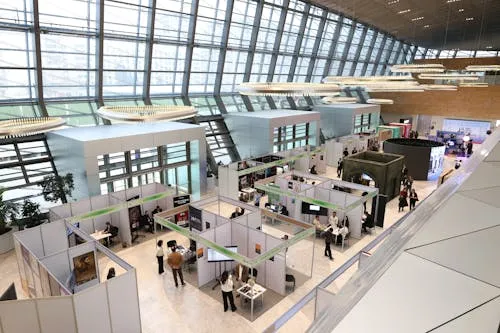

Good exhibition stand design can be the difference between a brand that gets remembered and one that gets walked past — and most businesses don't realise this until it's too late.
Trade shows and exhibitions are strange environments. Hundreds of companies crammed into a single hall, all competing for the attention of the same people walking the same aisles. In that kind of noise, your physical presence says everything before a single word is spoken. It tells visitors whether you're worth stopping for, whether you take your brand seriously, and whether they should bother picking up your brochure or handing over their contact details.
So why do so many brands still treat their stand like an afterthought?
First Impressions Are Formed in Seconds
We all know the saying about first impressions — but knowing it and acting on it are two very different things. Research consistently shows that people form judgments within the first few seconds of seeing something new. At an exhibition, that judgment happens as visitors scan the room from the entrance, or glance down an aisle while walking between meetings.
Your stand is essentially a shop window. And just like a well-dressed shop window draws people in off the street, a thoughtfully put-together stand pulls foot traffic in from the floor. Color, lighting, layout, signage — all of it communicates your brand's personality before your team has said a word.
If the stand looks cluttered, dated, or generic, visitors assume the brand is too. That might be unfair, but it's human nature. We make visual judgments fast, and we stick to them.
It's Not Just About Looking Good
Here's where a lot of brands go wrong — they confuse "looking impressive" with "being effective." A stand can be visually stunning and still fail to convert visitors into leads. Design that works for brand success isn't just about aesthetics. It's about function.
Think about the flow of the space. Where do people naturally enter? Where do you want them to linger? Is there a clear focal point that draws the eye? Is there space for private conversations, or does every interaction happen in full view of the aisle?
The best stands feel intuitive. Visitors don't have to work out what to do or where to go — they just follow the design. That ease of experience reflects well on the brand itself. If interacting with your stand feels smooth and considered, visitors begin to associate those qualities with your products and services too.
Your Stand Tells a Story
Every brand has something it wants people to understand — a value proposition, a personality, a promise. The challenge at exhibitions is communicating all of that without a thirty-minute presentation or a lengthy brochure.
This is where stand design becomes a form of storytelling. The materials you use, the way your logo is displayed, the imagery on your walls, the technology you incorporate — each element adds a line to the story you're telling. A brand that wants to communicate sustainability might lean into natural textures and earthy tones. A tech company might use clean lines, backlit panels, and interactive screens. A luxury brand might strip everything back to let quality materials do the talking.
None of this happens by accident. It requires intentional choices made well in advance, with a clear understanding of what the brand stands for and who it's trying to reach.
The Human Element Still Matters Most
For all the focus on design, it's worth saying clearly: the stand is the stage, not the performance. Your team are the ones who actually build relationships, answer questions, and turn visitors into clients. The design simply sets conditions that make those interactions more likely to happen.
A well-designed stand attracts the right people. It creates natural conversation starters — an interesting installation, a demo station, a bold piece of messaging that makes someone stop and ask a question. It gives your team something to work with, an environment that supports them rather than one they have to overcome.
There's also something to be said for staff morale. Working on a stand that looks great and functions well genuinely makes a difference to how your team presents themselves. Pride in the environment they're representing shows, and visitors pick up on it.
Budget Doesn't Have to Be a Barrier
One of the most common objections to investing properly in stand design is cost. And yes, high-end custom builds with bespoke fabrication and premium finishes can be expensive. But smart design isn't exclusively the domain of big budgets.
Modular systems, clever use of printed graphics, and good lighting can transform even a modest space. Many brands achieve remarkable results with relatively simple structures because the thinking behind the design is strong. A clear message, a consistent visual identity, and a well-planned layout will outperform an expensive but confused stand every single time.
The key is to start with strategy, not with a supplier catalogue. Know what you want visitors to feel, think, and do when they encounter your brand — and then build the design around those outcomes.
Long-Term Brand Building Happens in Person
We live in a digital world, and most brand touchpoints now happen on a screen. That's exactly why physical presence at exhibitions has become more valuable, not less. When someone stands in front of your stand, holds your product, speaks to your team, and walks away with something tangible — that experience lodges in memory in a way that a social media post simply cannot replicate.
Exhibitions are one of the few remaining spaces where brands get to create a fully immersive, multi-sensory experience — and a generic booth rarely does that justice. If it looks templated, it feels templated.
That's the real argument for going custom.
A custom exhibition stand is built entirely around your brand — its personality, its audience, and the outcomes you want from each event. The result is a space visitors genuinely stop for, before your team has even said hello.
Sensations Worldwide brings over 21 years of experience to exactly this challenge, designing bespoke stands that are tailor-made to each brand's unique requirements — not borrowed from a catalogue. What sets them apart is the balance they strike: their custom builds are unique and creative, yet modular and reusable — an asset that works across multiple events, not a one-time installation.
With offices and production facilities across Europe and the USA, and over 5,000 projects delivered, they bring both the scale and the expertise to get it right.






















Sign in to leave a comment.