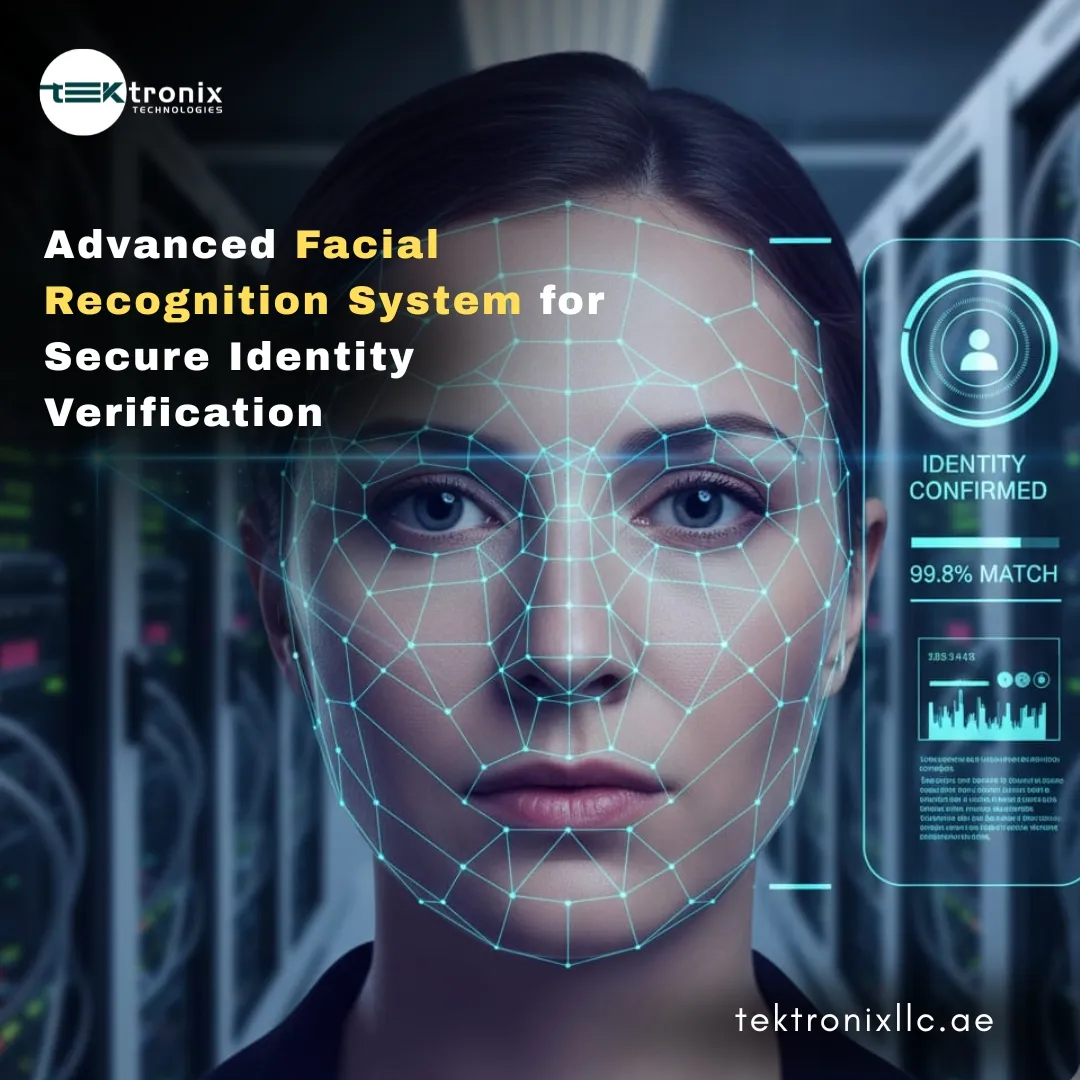

The United Arab Emirates has become one of the world's most ambitious test beds for smart-city technology, digital governance, and AI-powered infrastructure. At the centre of this shift is facial recognition — a biometric technology that is rapidly moving from niche application to operational standard across every major sector. From the soaring terminals of Dubai International Airport to the government ministries of Abu Dhabi and the industrial corridors of Sharjah, organisations are deploying intelligent identity systems that are faster, more accurate, and more secure than any manual alternative. 
This article explains how facial recognition works, why the UAE is uniquely positioned to lead global adoption, and how Tektronix LLC delivers end-to-end deployment across Dubai, Abu Dhabi, and Sharjah. Whether you are evaluating your first installation or scaling an existing security infrastructure, this guide gives you the full picture.
What Facial Recognition Technology Actually Does?
At its most fundamental level, facial recognition is an AI-powered biometric system that analyses the unique geometric and structural features of a human face — the distance between the eyes, the contour of the jaw, the depth of the nose bridge — and converts them into a mathematical template. That template is then compared against a database in real time to make an identity decision in milliseconds.
The technology operates in three distinct modes depending on the use case. In one-to-many mode, the system searches an entire enrolled database to find a matching identity — this is facial identification. In one-to-one mode, it simply confirms whether the person presenting themselves matches a single specific record — this is facial authentication. In detection-only mode, the system locates and isolates faces within an image or video frame without performing any matching — this is face detection, and it forms the essential first layer of every deployment.
Each of these functions requires specialised facial recognition software to manage the processing pipeline, and purpose-built facial recognition devices to capture the biometric data at entry or verification points. Understanding how these components interact is the starting point for any successful deployment.
Face Detection: The Foundation Every System Depends On
Face detection is the process of locating human faces within an image or live video stream in real time. Before any matching or verification can occur, the system must first confirm that a face is present, properly framed, and of sufficient quality to yield a reliable biometric reading. Without accurate face detection, even the most sophisticated identification engine will produce unreliable results.
Modern face detection algorithms use deep convolutional neural networks to handle the full range of real-world conditions: variable lighting, partial occlusion from glasses or masks, non-frontal angles, and mixed crowds where multiple faces may appear simultaneously within a single frame. The detection layer also performs a liveness check — confirming that the image presented is a live person and not a photograph or video replay — which is a fundamental anti-spoofing requirement in high-security environments.
For UAE deployments, face detection hardware must perform reliably in the region's characteristic environmental conditions: intense natural light from floor-to-ceiling glazed facades, the high ambient temperatures of outdoor entry points, and the dust typical of industrial and logistics environments in Sharjah. Tektronix LLC specifies camera hardware and sensor configurations that maintain detection accuracy across all of these conditions without performance degradation.
Facial Identification: Recognising Individuals Across Large Populations
Facial identification is the process of searching a biometric database to determine who a detected face belongs to. Unlike authentication — which only asks 'is this the person they claim to be?' — facial identification asks 'who is this person?' from among potentially thousands or millions of enrolled records.
This capability is essential in environments where individuals cannot be expected to pre-register or actively present a credential. Border control checkpoints, public transport hubs, and large-scale event venues all depend on facial identification to process high volumes of people efficiently. A system performing facial identification at Dubai International Airport, for example, must search a database of millions of traveller records and return a confirmed identity match in under a second — all without requiring the traveller to slow their pace.
Tektronix LLC deploys facial identification systems calibrated for both the scale and the regulatory context of UAE operations. Every identification event generates a timestamped audit record that meets the evidentiary standards required by Dubai Civil Defence, Abu Dhabi government security frameworks, and the access control compliance mandates applicable to Sharjah's free zones.
Facial Authentication: Confirming Access Rights with Precision
Facial authentication replaces the traditional credential — a PIN, password, access card, or fingerprint — with a person's face. The system performs a one-to-one comparison between the live biometric presented and the enrolled template on record for that specific individual, and returns a pass or deny decision in real time.
The practical advantages of facial authentication are significant in the UAE context. It eliminates the risk of credential sharing, lost access cards, and PIN compromise — vulnerabilities that remain endemic in conventional access control systems. It is inherently contactless, which aligns with hygiene requirements that have become permanent fixtures of facility management across the region's healthcare campuses, hospitality venues, and corporate headquarters. And it is fast: a well-configured facial authentication system processes a verification event in under 0.5 seconds, allowing individuals to pass through access points at walking speed without creating queues.
For environments requiring elevated assurance — data centres, pharmaceutical storage areas, government restricted zones — facial authentication can be combined with secondary factors such as Emirates ID verification or a PIN to create multi-factor authentication workflows. Tektronix LLC designs these layered architectures as standard for high-security UAE clients.
Facial Recognition Software: The Intelligence Behind the System
Every deployment is only as capable as its facial recognition software. The software layer manages the complete operational pipeline: receiving raw image data from detection hardware, extracting biometric templates, executing matching algorithms, managing enrolled databases, generating access decisions, logging audit trails, and integrating with adjacent building and security systems.
Enterprise-grade facial recognition software in the UAE context must satisfy several requirements simultaneously. It must process matching requests in real time, even under peak load conditions — a corporate headquarters receiving hundreds of employees within a 30-minute arrival window, for example. It must maintain accuracy across the full demographic range of the UAE's remarkably diverse resident and visitor population. It must integrate with the access control platforms, CCTV management systems, visitor management software, and HR directories that UAE organisations already operate. And it must handle data in compliance with the UAE's Personal Data Protection Law and any sector-specific data sovereignty requirements applicable to government or healthcare clients.
Tektronix LLC evaluates, specifies, and deploys facial recognition software from proven enterprise vendors — selecting platforms based on independently validated accuracy benchmarks, regional deployment track records, and the specific integration requirements of each client's existing infrastructure. Every software deployment is configured and tested by certified engineers before going live.
Facial Recognition Devices: Hardware Built for UAE Environments
A facial recognition device is the physical interface through which users interact with the system. It houses the camera sensor, the infrared illuminator for low-light and anti-spoofing performance, the onboard processing unit, and the credential reader — typically supporting RFID, smart card, Emirates ID, or QR code inputs for multi-factor configurations.
Selecting the appropriate facial recognition device for each deployment point requires matching hardware specifications to the environmental and operational profile of the location. Indoor lobby terminals in a premium Dubai commercial tower carry different requirements than outdoor perimeter devices at an industrial facility in Sharjah, or high-throughput lane devices at a transport interchange in Abu Dhabi. Key hardware specifications include the IP ingress protection rating, the operating temperature range, the sensor resolution and field of view, the onboard processing capability for edge-based matching, and the physical form factor.
Tektronix LLC's hardware portfolio covers the full range of deployment scenarios: wall-mounted terminals, turnstile-integrated devices, standalone kiosks, vehicle lane recognition cameras, and mobile units for temporary or event-based deployment. Every facial recognition device specified for outdoor UAE installation carries a minimum IP65 rating and is validated for operation across the Gulf's ambient temperature range.
Facial Recognition in the UAE: The Regional Context
The UAE's position as a global leader in facial recognition adoption is not accidental. Several structural factors make the country an exceptionally strong environment for large-scale biometric deployment.
The UAE's existing digital identity infrastructure — anchored by the Emirates ID system — provides a national biometric foundation that enterprise facial recognition systems can integrate with directly. The government's sustained investment in smart-city initiatives across Dubai and Abu Dhabi has created regulatory frameworks, procurement standards, and technical infrastructure that actively support advanced AI deployment. And the country's unique demographic profile — a population drawn from over 200 nationalities, with very high rates of cross-border travel and high-frequency facility access across concentrated urban areas — creates exactly the conditions where automated biometric identity management delivers the greatest operational return.
Compliance is a defining factor in UAE deployments. Facial recognition UAE-wide operates within the Personal Data Protection Law (Federal Decree-Law No. 45 of 2021), which governs the collection, storage, and processing of biometric data. Sector-specific frameworks — including the Dubai Health Authority's data governance standards, the requirements applicable to DIFC and ADGM regulated entities, and the civil defence access control mandates affecting buildings of a certain occupancy class — add further compliance layers that must be designed into deployments from the outset.
Facial Recognition in Dubai: Precision for the World's Most Demanding City
Dubai's combination of global business activity, international tourism, architectural ambition, and exacting regulatory standards creates a facial recognition deployment environment unlike anywhere else. Facial recognition Dubai-based installations must perform to the standards of the world's most scrutinised real estate and public space portfolio — from the financial towers of DIFC and Business Bay to the retail and hospitality complexes of Downtown Dubai and the transport infrastructure of Dubai Metro's extended network.
Tektronix LLC's facial recognition Dubai deployments span corporate access control, hotel and hospitality guest management, healthcare campus entry, and retail analytics. Every Dubai installation is engineered in compliance with Dubai Civil Defence requirements and the specific technical standards of the applicable free zone or regulatory authority — DIFC, JAFZA, DAFZA, Dubai Internet City, and others. The design aesthetic of Dubai's landmark buildings is also a genuine consideration: Tektronix LLC specifies slim, architecturally integrated facial recognition devices that complement premium interiors without visual compromise.
Facial Recognition in Abu Dhabi: Institutional-Grade Security for the Capital
Abu Dhabi's built environment is defined by government ministries, financial institutions, healthcare campuses, and the expanding residential and commercial districts of Al Reem Island, Saadiyat, and Khalifa City. Facial recognition Abu Dhabi deployments carry heightened requirements around data sovereignty, on-premise processing, and integration with government-grade security infrastructure — requirements that are non-negotiable for institutional clients operating under Abu Dhabi's regulatory frameworks.
Tektronix LLC's facial recognition Abu Dhabi installations are configured to process and store all biometric data within the client's own network perimeter wherever mandated, with no dependency on external cloud processing for identity-critical operations. Integration with Abu Dhabi's existing government identity databases, visitor management systems, and emergency response platforms is handled through certified API connections designed and tested by Tektronix LLC's engineering team.
Facial Recognition in Sharjah: Robust Deployment for Industrial and Logistics Environments
Sharjah's economy is anchored in industrial manufacturing, logistics, and port operations — sectors with demanding physical environments and complex access control requirements. Facial recognition Sharjah deployments must handle shift-based workforce access across large perimeter areas, contractor and third-party visitor management, zone-specific access authorisation for industrial safety compliance, and hardware conditions that include high temperatures, dust ingress, and outdoor exposure.
Tektronix LLC's facial recognition Sharjah installations use industrial-grade facial recognition devices rated for outdoor Gulf conditions — IP65 or higher ingress protection, extended operating temperature ranges, and anti-tamper housings. Contractor induction verification workflows, PPE compliance checkpoints, and multi-shift access tracking are standard configuration elements for Sharjah industrial deployments, providing the operational accountability that Sharjah's free zone regulatory frameworks require.
Integration: Facial Recognition as Part of a Unified Security Architecture
A facial recognition system operating in isolation is a verification tool. A facial recognition system integrated into a building's complete security and operational infrastructure is a real-time intelligence layer that transforms how facilities are managed.
Tektronix LLC's deployments connect facial recognition software directly with access control credential management systems, CCTV and video analytics platforms, building management systems for environmental and occupancy response, HR and employee directory systems for host notification, and emergency evacuation platforms for accurate real-time mustering. Every access event becomes a multi-system data point: when a face is authenticated at an entry lane, the system simultaneously updates occupancy records, logs the event against the individual's identity profile, triggers camera capture at the relevant point, and updates the live evacuation register.
Future-ready installations include AI-powered visitor pre-enrolment via mobile app, cloud-based policy management for multi-site estate administration, and predictive analytics that use access flow data to inform staffing and operational decisions. Tektronix LLC designs every deployment with this integration architecture in mind from the outset — ensuring that the system delivers value beyond the access point itself.
Conclusion
Facial recognition is no longer an emerging technology in the UAE — it is a present operational reality across every major sector of the country's economy and public infrastructure. Organisations that deploy strategically, with the right combination of face detection accuracy, facial identification capability, facial authentication precision, enterprise facial recognition software, and fit-for-purpose facial recognition devices, gain a security and efficiency advantage that compounds over time.
Tektronix LLC brings regional expertise, certified engineering capability, and an ongoing support infrastructure to every deployment across facial recognition UAE-wide operations — from facial recognition Dubai's landmark commercial towers to facial recognition Abu Dhabi's institutional campuses and facial recognition Sharjah's industrial facilities.
FAQs
1. What is the difference between facial identification and facial authentication?
Facial identification is a one-to-many process: the system searches an entire enrolled database to determine who an unknown individual is. Facial authentication is a one-to-one process: the system confirms whether a specific person presenting themselves matches a single record already on file. Identification is used in border control and public safety applications; authentication is used in access control, where individuals are expected to be pre-enrolled and are verifying their right to enter a specific area.
2. How does facial recognition software handle the UAE's diverse population?
Enterprise facial recognition software platforms deployed by Tektronix LLC are trained and validated on demographically diverse datasets that include representation across the broad range of nationalities resident in the UAE. Accuracy benchmarks are verified across demographic groups before any system goes live, and ongoing performance monitoring is built into the support contract to detect and address any drift in recognition accuracy over time.
3. What makes a facial recognition device suitable for outdoor deployment in the UAE?
An outdoor-rated facial recognition device for UAE conditions must carry a minimum IP65 ingress protection rating to resist dust and water, operate reliably across the ambient temperature range typical of the Gulf — up to 55°C at peak summer — and use infrared illumination rather than visible-light sensors to maintain face detection accuracy under direct sunlight. Anti-tamper housings and vandal-resistant enclosures are standard for perimeter-facing devices in industrial and logistics environments.
4. Is facial recognition in the UAE compliant with data protection regulations?
Yes, when properly designed and implemented. Facial recognition UAE-wide operations are governed by Federal Decree-Law No. 45 of 2021 (the UAE Personal Data Protection Law), which classifies biometric data as sensitive personal data requiring explicit consent or a legitimate legal basis for processing. Tektronix LLC designs every deployment with compliance as a foundational requirement — including data minimisation, encrypted storage, defined retention periods, and audit logging — and configures on-premise processing for clients in regulated sectors where data sovereignty mandates prohibit cloud-based biometric handling.
5. How long does it take to deploy a facial recognition system for a large facility in Dubai or Abu Dhabi?
Deployment timelines depend on facility scale, the complexity of existing infrastructure, and the integration requirements of adjacent systems. A single-entry-point facial recognition Dubai or facial recognition Abu Dhabi installation can typically be completed within two to three weeks from site survey to go-live. A multi-site enterprise deployment across several locations, integrating with existing access control, CCTV, and HR systems, typically requires six to twelve weeks of planning, configuration, installation, integration testing, and staff training. Tektronix LLC provides a detailed project timeline as part of the initial deployment assessment.




























Sign in to leave a comment.