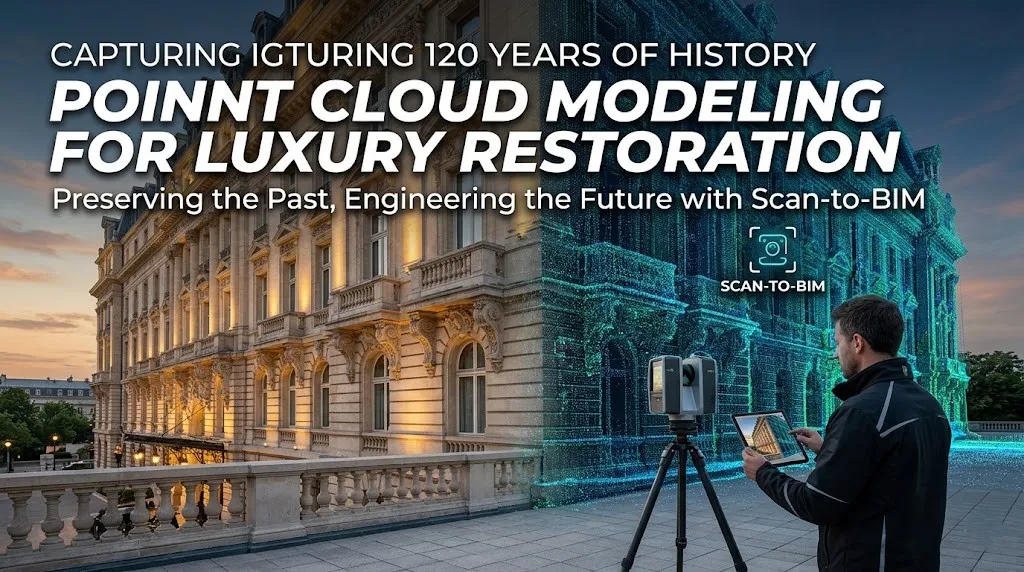

Did you know that nearly 40% of the total AEC market output in developed economies is now directed toward the renovation and retrofit of existing structures? When that structure is a century-old icon of luxury, the stakes transition from mere construction to a high-wire act of cultural preservation. For a 120-year-old landmark, traditional 2D as-builts are often non-existent or dangerously inaccurate, leaving a margin of error that modern luxury standards simply cannot tolerate.
The Precision Imperative in Heritage Restoration
Restoring a luxury historical asset is a battle against "hidden geometry." Over 120 years, foundations settle, walls lean by fractions of a degree, and intricate artisanal moldings defy standard measurement. Industry research from firms like McKinsey suggests that unforeseen site conditions account for nearly 10% of total project cost overruns in complex renovations. In the world of high-end hospitality and heritage estates, these "surprises" can derail both the timeline and the architectural integrity.
Digital transformation, specifically through Scan-to-BIM workflows, has shifted from a "nice-to-have" to a project prerequisite. By utilizing terrestrial laser scanners (TLS), AEC professionals can capture millions of data points—a "point cloud"—to create a digital twin that is accurate within millimeters. This level of granularity is the only way to truly honor the original craftsmanship while integrating modern HVAC, MEP, and life-safety systems into a century-old envelope.
From Billions of Points to Actionable BIM Data
The transition from a raw point cloud to a functional Building Information Model (BIM) is where the real value is unlocked for stakeholders. While the raw data captures the "as-is" condition, the modeling process categorizes these points into intelligent elements.
1. Structural Fidelity and Deformation Analysis
For a 120-year-old structure, "straight" lines are often a myth. Point cloud modeling allows engineers to perform deformation analysis, identifying structural shifts that are invisible to the naked eye. By mapping the point cloud against an idealized CAD geometry, teams can visualize structural health and plan reinforcements without invasive testing.
2. Preserving the Artisanal "DNA"
Luxury restoration often involves replicating ornate plasterwork, hand-carved stone, or bespoke joinery. High-definition scanning captures these textures in 3D, allowing for the fabrication of replacement parts using CNC milling or 3D printing that matches the original work with 100% fidelity. This process is essential for maintaining "timeless elegance" in world-class assets. For instance, understanding how to preserve the timeless elegance of the 120-year-old Hotel Ritz requires a deep dive into how digital documentation honors historical aesthetics while meeting 21st-century building codes.
3. Clash Detection in Tight Envelopes
One of the greatest challenges in luxury restoration is hiding modern amenities (like high-speed fiber optics or VRF cooling systems) within historical voids. By using point cloud data, MEP engineers can run automated clash detection to ensure new ductwork doesn't intersect with a protected 19th-century ceiling joist, reducing field rework by an estimated 15-20%.
Navigating the Implementation Challenges
Despite the clear ROI, Point Cloud-to-BIM workflows are not without hurdles. Data management is a primary concern; a single high-resolution scan of a large luxury estate can exceed 50-100 GB of raw data. This requires robust cloud-based CDEs (Common Data Environments) to ensure that architects in London, engineers in New York, and contractors on-site are all working from the same "source of truth."
Furthermore, the "Level of Accuracy" (LOA) must be defined early. While a standard commercial renovation might require LOA 20 (roughly 15mm accuracy), a luxury restoration of a historical facade often demands LOA 30 or 40 (5mm to 1mm accuracy). Balancing this need for extreme detail with the project budget and timeline requires a nuanced understanding of both the technology and the architectural significance of the site.
Actionable Takeaways for AEC Leaders
To successfully leverage point cloud modeling in your next luxury restoration project, consider these strategic steps:
- Specify LOA Early: Clearly define the Level of Accuracy required for different zones of the building to optimize scanning costs.
- Prioritize Feature Extraction: Don't model everything. Focus on "high-value" elements like structural members and ornamental details while leaving secondary spaces at lower detail levels.
- Integrate Early with Facilities Management (FM): The BIM model created for restoration should serve as the foundation for the building’s digital twin, aiding long-term maintenance and operational efficiency for the hotel or estate owners.
- Verify Vendor Expertise: Ensure your Scan-to-BIM partner understands heritage-specific modeling, as standard automated "auto-surface" tools often fail to capture the nuances of historical geometry.
The Future: AI and the Automated Scan-to-BIM Workflow
As we look toward 2026 and beyond, the integration of AI and Machine Learning into point cloud processing is set to revolutionize the industry. We are moving toward "automated object recognition," where AI can instantly distinguish between a Corinthian column and a structural pipe within a point cloud.
For the AEC professional, this means less time spent on manual tracing and more time focused on the creative and engineering challenges of preservation. By embracing these digital tools, we aren't just renovating old buildings; we are ensuring that the architectural heritage of the last century survives, thrives, and remains functional for the next 120 years.



























Sign in to leave a comment.