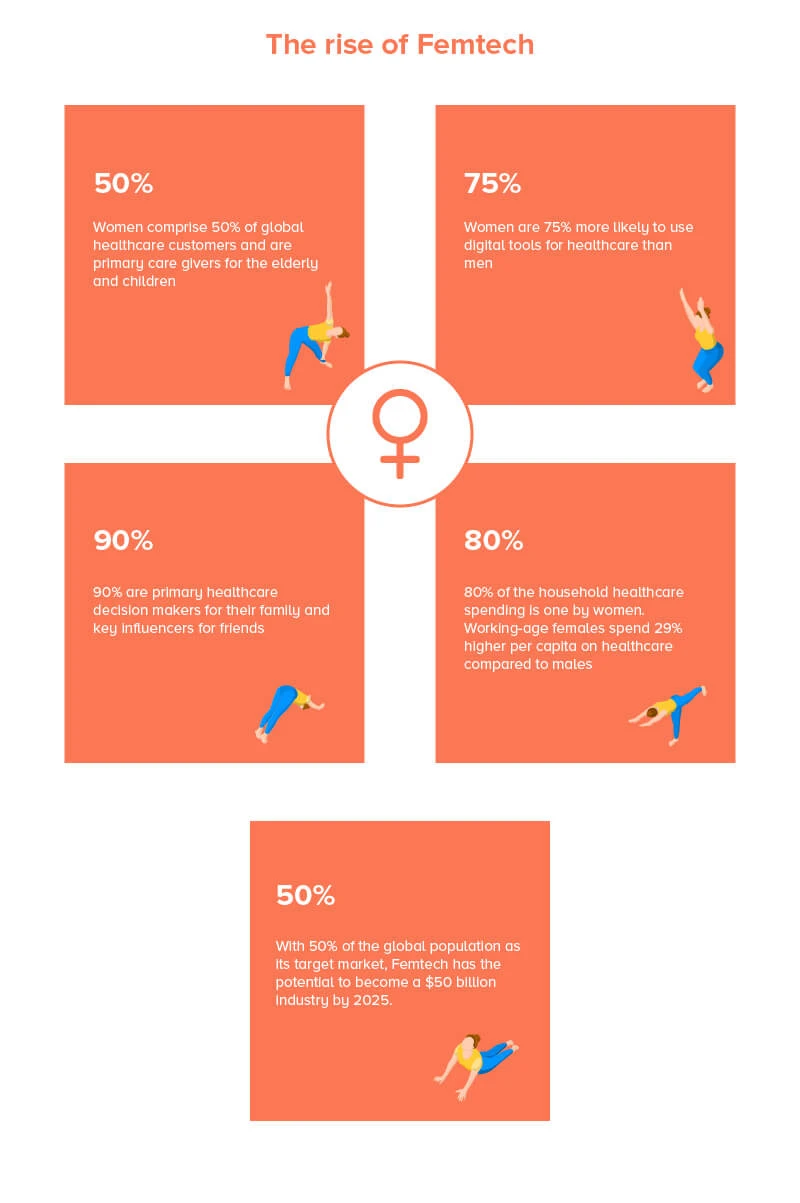

The global women health tracking application market size is expected to reach $3.9 billion by 2026 at a compounded annual growth rate (CAGR) of 17.9%, according to a new report by Grand View Research, San Francisco.
With technology addressing the many concerns, women are now more in charge of their bodies and have a strong understanding of their wellbeing. Health and wellness are taking the center stage with a multitude of global campaigns echoing the same.
In the mHealth apps category, apps for women’s health are the second most popular among adults and the first most popular among adolescent women.
Femtech has also received funding of over $800 million in recent years which suggests it is truly the right time to partner with women healthcare app developers and tap into this growth opportunity.
Benefits of Women Health Tracking App
Health and wellness apps for women primarily consist of period calendars or trackers. Such solutions are intended to help women track their menstrual cycles, predict ovulation, evaluate their moods, overall body health, and prevent them from taking birth control pills, etc. Such applications help women reduce their risk of unwanted pregnancies, better understand their bodies, and know how to respond to different health issues.
Provides women control of their health and lives
Femtech app aims to provide women more power over their health, joy, and wellbeing. Female health tracking apps provide good insights into body problems and help women make informed decisions when the need arises.
It also fosters scientific awareness about our bodily conditions. Femtech provides opportunities to better understand female bodies, hormones, etc.
Timely diagnosis and treatment of health issues
In addition to helping women understand their bodies and providing comprehensive medical expertise, Femtech also enables women to identify and treat their health issues timely. For instance, if periods are routinely monitored, abnormal cycles are detected well- in-time, many health issues will be diagnosed as early as possible.
Improving access to care in remote areas
It is the need of the hour to make healthcare accessible to women. Women’s healthcare issues are often considered taboo subjects which makes it even harder for them to seek healthcare advice and medical care, particularly for infertility, menstrual health, birth control, and sexual well-being.
By providing robust healthcare mobility solutions, digital healthcare chains are making healthcare accessible virtually to women in the comfort of their homes.












Sign in to leave a comment.