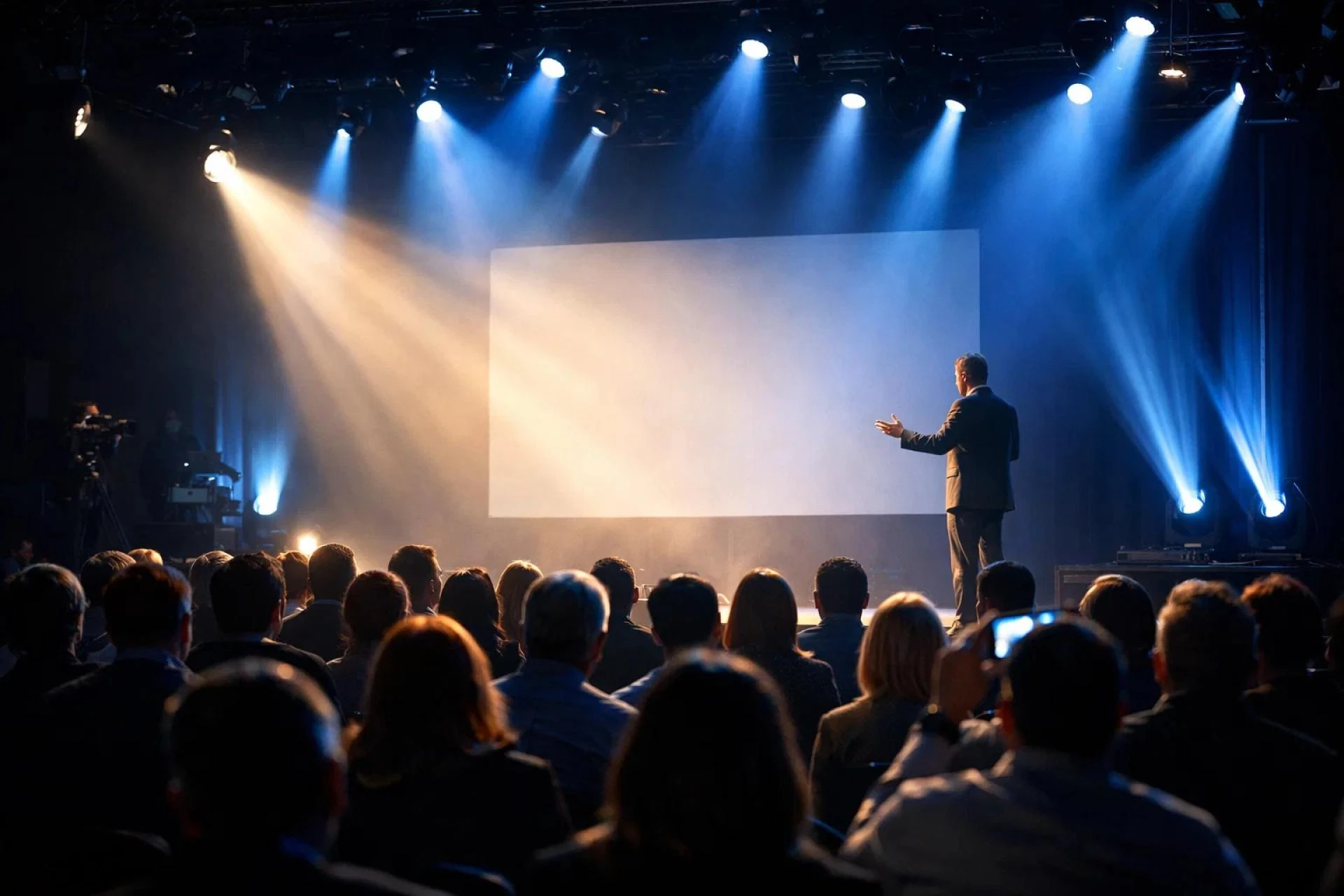

Audiences don’t lose attention all at once. It quietly fades away when visual focus wanes, when speakers merge with the background, and when the stage no longer dictates what is most important. At corporate events, stage lighting is key to commanding attention and influencing how information is received.
Lighting affects more than visibility. It also conveys hierarchy, indicates transitions, and cues when and where audiences should focus attention. When thoughtfully planned, it supports speakers and content without becoming a diversion in itself. When it does, it distracts and even alienates audiences.
Brightness establishes visual hierarchy
Brightness is the primary determinant of what and when people notice things. A brightly lit stage is the first thing a guest sees when entering a room. It immediately cements its relevance and importance. By contrast, a stage with little or no lighting renders the speaker visually irrelevant, even if they’re clearly audible.
Audiences can deal with a bit of backlighting or missing fill light on a presenter, but harsh, bright light or glare has a similar effect. The eyes are naturally drawn to bright things, so poorly planned brightness automatically siphons off attention.
The key is balance. Faces should be clearly visible without overly dramatic shadows. Presentation or display screens should remain visible without washing out the presenter. When brightness levels are dialled in, audiences remain visually engaged with the stage instead of scanning the room or tuning out.
Stage lighting often fails at this in corporate events by treating brightness as a technical setting rather than a strategic choice. Lighting that adjusts brightness according to room size and presentation conditions feels natural and holds attention.
Colour temperature influences tone
Colour temperature is a less obvious but powerful influence on tone and attention. Cooler colour temperatures appear cleaner and more professional. They work well for conferences, strategy sessions, and keynote speeches. Warmer temperatures have a conversational quality and are better suited to panels, informal chats, and closing remarks.
Unexpected colour temperature in lighting can be disorienting. A speaker on serious business outcomes presented in front of amber warm lighting that would be at home in a hotel lobby bar may seem like they’re “winging it” or lack authority. Bright cold light during an interactive or co-creation session can seem sterile or unfriendly.
Effective stage lighting is unobtrusive. Its colour temperature should complement the intended tone of the content and setting. When done well, audiences don’t notice but intuitively know whether to listen critically, reflectively, or open up for discussion.
Movement draws attention nonverbally
Movement is one of the most effective tools for grabbing and maintaining attention. Subtle lighting movement catches the eye more quickly than words. Used with restraint, movement can cue transitions like speaker changes, segment shifts, or the beginning of key moments.
The opening moments of a Q&A session might be prefaced by a slow lighting change to signal the end of presentation content and shift to dialogue. A spotlight on a keynote speaker after a video or slide interlude can immediately re-centre the room’s focus. In both examples, lighting movement reduces the audience’s cognitive load by providing visual structure.
Overuse of lighting movement has the opposite effect on attention. Rapid movement, constant colour changes, and “busy” effects steal attention from speakers and content. Successful corporate lighting uses movement to complement and enhance pacing, not as a rival point of focus.
Lighting helps define speaker authority
Visibility matters. Viewers equate it with lucid communication, even if subconsciously. Speakers who are poorly lit come across as disorganised and less assured, regardless of how well they may actually be performing.
A frontal light that lights up the face and allows eye contact is best. Side and backlighting add dimension without blurring. Horizontal shadows across faces or lecterns break the connection and erode trust.
Stage lighting should frame the speaker as the scene’s intended focal point to reinforce their authority without spectacle. This becomes even more important in executive presentations, investor briefings, or leadership announcements.
Panel discussions and multi-speaker events require more care
Panel discussions and multi-speaker events further complicate lighting. Multiple speakers seated or moving across a stage need even coverage. Audiences will automatically pay more attention to the brightest individual, even if they’re not the active speaker.
Balanced lighting across a panel ensures attention remains on the conversation. Strategic adjustment can shift focus to the active speaker without unduly dimming others. It prevents the visual hierarchy of the stage from undermining the flow of the discussion.
Lighting for panels often becomes static and ineffective without planning. It fails to refocus attention during long discussions and leads to audience disengagement.
Lighting reinforces memory and retention
Attention is linked to memory. Vision affects understanding and retention. People remember better when speakers and visual cues are easy to see.
Vision-friendly lighting, where audiences can focus and easily take in visual information during presentations, means they’ll be more likely to attend the presentation for longer. This is especially important for all-day conferences and corporate events that take place over a series of sessions where tiredness builds up.
Stage lighting influences how audiences focus, interpret, and remember corporate events. When used thoughtfully, it can bolster engagement without becoming a distraction in its own right. For companies planning corporate events, it’s worth working with professional events hire in Perth, for lighting expertise that supports, not fights against, communication objectives.












Sign in to leave a comment.