

Introduction
In the dynamic world of technology and software development, programming languages play a vital role in shaping applications and solutions. Among the myriad of languages available today, Python has carved a unique niche due to its simplicity, versatility, and power. Whether you're building a simple automation script or developing sophisticated artificial intelligence models, Python is often the go-to language. This blog explores the essence of Python from its origins to its modern-day applications, features, and benefits, making it one of the most preferred programming languages in the world.
What is Python?
Python is a high-level, interpreted programming language known for its readable and concise syntax. Designed to be easy to understand and write, it supports multiple programming paradigms, including procedural, object-oriented, and functional programming. It is open-source and maintained by the Python Software Foundation (PSF). Python’s design philosophy emphasizes code readability and allows developers to express concepts in fewer lines of code compared to other languages like Java or C++. Unlock your coding potential with a hands-on Python Course in Bangalore, designed for beginners and professionals alike.
A Brief History of Python
Python was created by Guido van Rossum in the late 1980s and was first released in 1991. Van Rossum wanted to design a language that emphasized code readability and allowed programmers to write clean and logical code for small and large-scale projects alike.
The name “Python” was inspired not by the snake, but by the British comedy group Monty Python. Over the years, Python has evolved significantly:
- Python 2.x was released in 2000 and remained popular for many years.
- Python 3.x, introduced in 2008, was not backward compatible with Python 2.x and came with improved features and performance.
Python 2 officially reached its end of life in 2020, with Python 3 now being the standard version used globally.
Key Features of Python
Python’s popularity stems from several defining features:
- Simplicity and Readability: Python's syntax is clear and easy to understand, making it ideal for beginners.
- Interpreted Language: Python code is executed line by line, which simplifies debugging.
- Cross-platform Compatibility: Python runs on all major operating systems—Windows, macOS, Linux.
- Extensive Standard Library: It comes with a rich set of modules and functions that support regular expressions, file I/O, web services, and more.
- Dynamic Typing: No need to declare data types explicitly.
- Open Source and Community Support: Python is free and has a massive global community of contributors and learners.
- Integration Capabilities: Python can easily integrate with C, C++, Java, and other languages.
Popular Python Libraries and Frameworks
Python’s ecosystem is vast and supported by a wide range of libraries and frameworks:
- NumPy & Pandas: For data manipulation and numerical computations.
- Matplotlib & Seaborn: For data visualization.
- TensorFlow & PyTorch: For deep learning and AI.
- Django & Flask: For web development.
- BeautifulSoup & Scrapy: For web scraping.
- OpenCV: For image and video processing.
- Selenium: For automation testing.
These libraries enhance Python’s capabilities, making it a top choice for many domains.
Applications of Python
Python is a general-purpose language with a wide array of real-world applications:
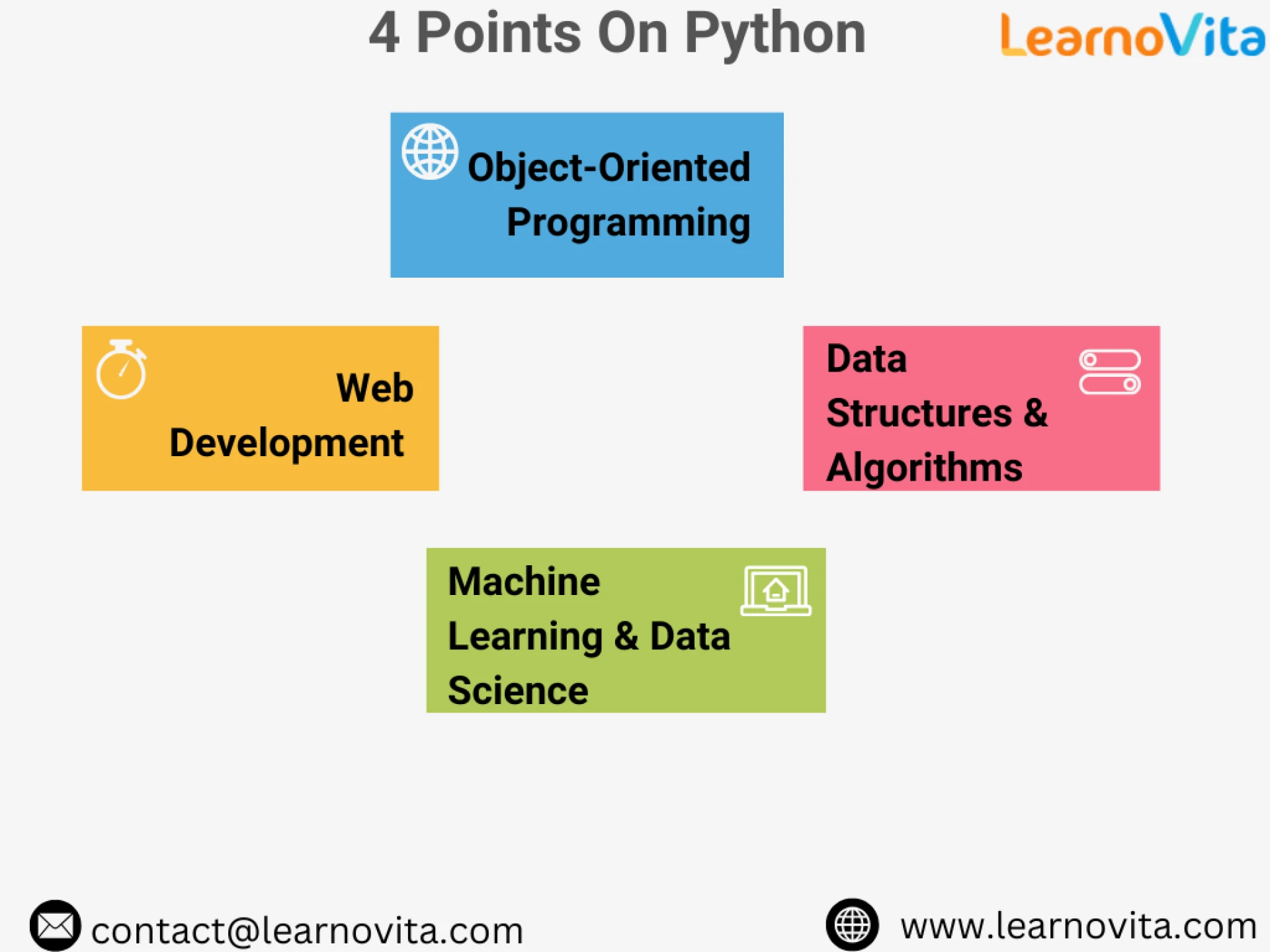
1. Web Development
Frameworks like Django and Flask allow developers to build secure and scalable web applications quickly.
2. Data Science & Analytics
Python is the dominant language in the data science ecosystem due to libraries like Pandas, NumPy, and Scikit-learn.
3. Artificial Intelligence & Machine Learning
Libraries such as TensorFlow, Keras, and PyTorch make Python ideal for training and deploying ML models.
4. Automation and Scripting
Python is widely used for writing automation scripts—handling repetitive tasks like file manipulation, data scraping, and email sending.
5. Game Development
Python has libraries like Pygame which can be used for building simple games.
6. Desktop GUI Applications
Frameworks like Tkinter and PyQt support building user-friendly desktop apps.
7. Cybersecurity and Ethical Hacking
Python scripts are commonly used for vulnerability scanning, penetration testing, and creating network tools.
8. Internet of Things (IoT)
Python is often used in IoT devices like Raspberry Pi for programming sensors and devices.
Kickstart your programming journey with a comprehensive Python Online Course, accessible anytime, anywhere.
Why Learn Python?
Here are some compelling reasons why Python is an excellent language to learn, whether you’re a beginner or an experienced developer:
- Beginner-Friendly: Python’s simplicity makes it ideal for those new to programming.
- In-demand Skill: Python developers are in high demand, with strong salary prospects.
- Versatility: It can be used for web apps, AI, automation, games, and more.
- Career Opportunities: Python is the language of choice in industries like finance, healthcare, education, and e-commerce.
- Community and Resources: A vast collection of tutorials, documentation, forums, and courses is available online.
Getting Started with Python
To begin your Python journey:
- Download and Install: Visit python.org to download the latest version.
- Choose an IDE: Use editors like VS Code, PyCharm, or Jupyter Notebook.
- Start Writing Code: Begin with basic syntax, loops, functions, and gradually explore libraries.
- Take Courses: Enroll in beginner-to-advanced Python online courses to deepen your skills.
- Work on Projects: Build small apps, contribute to GitHub projects, or create scripts for practice.
Real-World Use Cases of Python
Here are some well-known companies and use cases of Python:
- Google: Uses Python for internal systems and AI projects.
- Instagram: Built with Django, a Python-based web framework.
- Netflix: Uses Python for data analytics and content recommendations.
- Spotify: Leverages Python for backend services and data processing.
- NASA: Employs Python in various scientific and computational applications.
Conclusion
Python is not just a programming language it’s a tool that empowers innovation across industries. Its elegant syntax, vast library support, and strong community have made it the preferred language for developers, data scientists, engineers, and educators worldwide. Whether you're automating tasks, building cutting-edge AI models, or simply learning to code, Python is the smart, scalable, and reliable choice. Embrace it today and open the doors to a world of opportunities in technology.













Sign in to leave a comment.