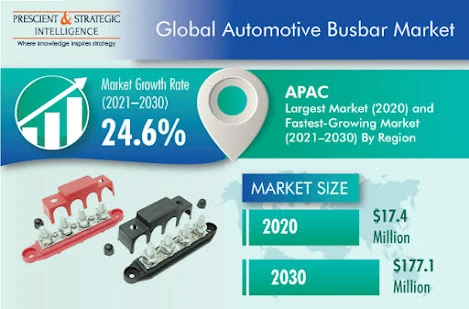

A metallic strip or bar called a busbar serves as a conduit for distributing electricity in a system. Copper, aluminum, bronze, or other effective alloys with high conductivity and minimal energy loss during transmission are the metals that are employed.
Aluminum is frequently used because of its greater electrical conductivity. For safety, the busbar may be fully or partially insulated. It is frequently protected by enclosures for switch panels, panel boards, switchgear, and busways. Busbar has strong mechanical strength, can withstand high temperatures, and can dissipate heat.
Additionally, it is predicted that technical advancements in EV production and charging infrastructure would favor the worldwide automotive busbar market. These factors will help the market to produce $177.1 million revenue by 2030.
Factors Driving Demand for Automotive Busbar
The paucity of room in modern automobiles is the primary factor behind the introduction of busbars. Power and data lines are necessary for each sensor, actuator, and electric/electronic component in a vehicle, as well as all of the packing space they require.
Busbars\' lower-profile routing makes room for additional electrical content because they do not sit as high as wires do. Additionally, they can be bent at angles more accurately and tightly than a cable can, closely conforming to vehicle shapes.
The requirement for mechanized assembly is the second factor. Even though a lot of automotive assemblies are now automated, wire installation is still mostly a human process. Robotic arms may find it extremely challenging to grip a wire harness and properly install it in a car because of its flexibility.
In comparison, moving a rigid busbar into place is significantly simpler for a robot. Given that EVs use a lot of power and potentially expose assembly workers to strong electric currents, automated assembly is less costly from a labor perspective, it allows for improved quality, and it is safer.
One of the key factors fueling the market\'s expansion is the growing awareness of busbars\' cost- and energy-effectiveness. Busbars also save production expenses and internal material handling by speeding up assembly.
As a result, firms that make cars are more likely to use busbars than wires. Busbars also make retrofitting easier due to shifting loads and the need for less space, which has increased demand for them in motor control center applications and contributed to the market\'s expansion.
Explore the Thriving Automotive Busbar Market and Its Growth Prospects






























Sign in to leave a comment.