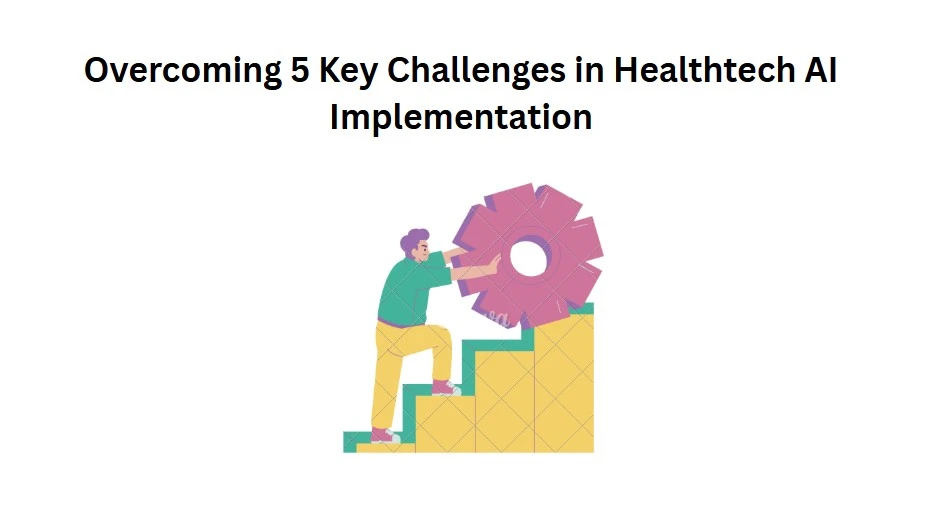

From diagnostic imaging and virtual assistants to drug discovery, healthcare organizations are increasingly leaning on AI to deliver faster, more accurate, and more personalized care. But moving from POC to real-world performance isn’t linear.
Healthtech companies face deep-rooted challenges when implementing AI. Data compliance issues, integration hurdles, clinician trust, and model generalization—all these factors can stall or derail adoption. And unlike many other industries, in healthcare, stakes aren’t just financial—they’re clinical.
Here’s a breakdown of five key implementation challenges, and how experienced healthtech AI teams are addressing them:
Data Quality and Interoperability
Healthcare data is notoriously fragmented, inconsistent, and buried in siloed systems. Different providers, EHR vendors, and departments store data in formats that don’t easily talk to each other.
What’s working:
- Using FHIR as a foundation to standardize data exchange between systems.
- Implementing data lakes and synthetic data generation to improve training datasets where real-world data is sparse or protected.
- Partnering with clinical informaticists early to define data collection protocols that align with AI model needs.
Also Read: 5 Ways AI is Solving Healthcare’s Biggest Challenges
Privacy, Security, and Regulatory Compliance
HIPAA and local healthcare privacy laws add a heavy layer of scrutiny to any AI deployment involving patient data. A misstep can result in legal penalties, reputational damage, and—most critically—loss of patient trust.
What’s working:
- Adopting federated learning models that allow training on decentralized datasets without moving or exposing sensitive patient data.
- Using differential privacy and de-identification techniques to anonymize datasets while preserving analytical value.
- Embedding compliance by design into the development lifecycle—ensuring that AI workflows, storage, and access controls pass audits before they launch.
Clinician Trust and Adoption
Even with high model accuracy, if clinicians don’t understand or trust the AI’s output, adoption stalls. Black-box algorithms without explainability create more friction than value in real-world workflows.
What’s working:
- Prioritizing explainable AI (XAI) that highlights the reasoning behind predictions, especially in diagnostics and treatment planning.
- Co-designing tools with clinical stakeholders to ensure AI enhances, not interrupts, existing workflows.
- Running prospective validation studies in clinical settings to build confidence and peer-reviewed evidence.
Integration into Existing Infrastructure
Many healthcare systems still operate on legacy infrastructure or closed-loop EHR systems. Injecting AI into these environments—without causing delays, errors, or workflow disruption—is a significant challenge.
What’s working:
- Deploying AI via APIs and microservices that sit alongside legacy systems instead of attempting deep integrations from day one.
- Using cloud-native health platforms that allow model deployment, scaling, and monitoring in a modular way.
- Introducing AI layer middleware that acts as an interpreter between models and hospital systems.
Generalizability and Bias
AI models trained on data from one geography, hospital type, or demographic often fail to perform reliably across broader populations. This introduces clinical risk, regulatory pushback, and ethical concerns.
What’s working:
- Curating diverse and representative training datasets to reduce bias and improve generalizability across ethnicities, ages, and disease states.
- Continuously monitoring model drift and retraining with new datasets to preserve accuracy as environments change.
- Setting up bias detection pipelines that flag disparities in model performance and trigger interventions.
Key Takeaway
AI in healthtech isn’t a plug-and-play upgrade—it’s a precision tool that must be integrated thoughtfully, transparently, and securely. The organizations moving fastest aren’t just solving technical problems. They’re solving trust, interoperability, compliance, and change management in parallel. That’s where real impact begins.









Sign in to leave a comment.