
Have you noticed users logging in just to complete one task and logging out immediately?
Or wondered why feature adoption stays low even after investing heavily in onboarding, tutorials, and support?
This is one of the most common problems in modern B2B SaaS: people stop engaging after some point.
SaaS platforms are getting smarter and more advanced. But still, many users feel lost, disconnected, or overwhelmed.
So, how do you make software feel easier, more intuitive, and more human, without adding more UI clutter or support tickets? Well, the solution is voice AI.
This article examines what the engagement gap looks like, why voice AI is important in B2B, and how it helps improve engagement.
What the Engagement Gap Looks Like in Modern B2B SaaS
Let us consider that you’re the head of operations at a mid-sized tech company. For one project, you onboard your team on a new SaaS platform. There’s a lot of confusion on the part of your teams.
Two weeks later, the tool is barely used. Only a handful of features get regular attention. Most users revert to old habits, spreadsheets, WhatsApp threads, and scattered emails.
That’s the engagement gap in action:
- Users log in but don’t interact deeply
- Features go unexplored
- Teams fail to adopt the platform as a part of their workflow
- ROI shrinks, and churn rises
Did you know that user engagement directly correlates with retention? Companies with strong engagement across multiple channels (app, email, web) retain 89% of their customers, while those with weak engagement retain only 33%.
This means that the lower your engagement, the higher your churn. And in the SaaS world, churn is something businesses don’t want.
So, why does this happen?
There are three common causes:
- Complex interfaces: Users get lost or overwhelmed.
- Lack of personalized guidance: The software feels robotic, and it does not have personalization.
- Poor onboarding experience: Users aren’t sure where to start or what to click.
And here's the key: traditional UI/UX improvements help, but they’re not enough.
People don’t just want efficient. They want connected, intuitive, and responsive experiences.
That’s where voice AI becomes significant.
Importance of Voice AI in B2B SaaS
Reduces cognitive load for users
Users can simply ask what they are searching for, instead of going everywhere and checking all the features manually. This makes the platform easier to use for non-technical teams as well.
Makes software feel human, not mechanical
Voice-based interaction creates an experience that closely resembles real human dialogue. This helps users feel supported rather than confused or isolated while using the platform.
Accelerates time-to-value
Voice AI helps users reach their goals. They are guided strategically to what they want to accomplish. This removes trial-and-error clicks and saves users' time.
Improves onboarding and feature discovery
New users can explore features by asking questions naturally, while existing users uncover advanced functionality they might otherwise miss.
Closes the gap between data and decisions
Voice AI can communicate insights from a dashboard to a particular user. This enables leaders to understand performance instantly instead of interpreting complex reports.
Scales support without increasing costs
You can handle common questions and workflows instantly through voice and reduce dependency on support teams while maintaining a high-quality experience.
Drives consistent, daily engagement
When interaction feels effortless, users return more often, which turns a SaaS product into a daily operational tool rather than an occasional one.
How Voice AI Can Enhance User Engagement
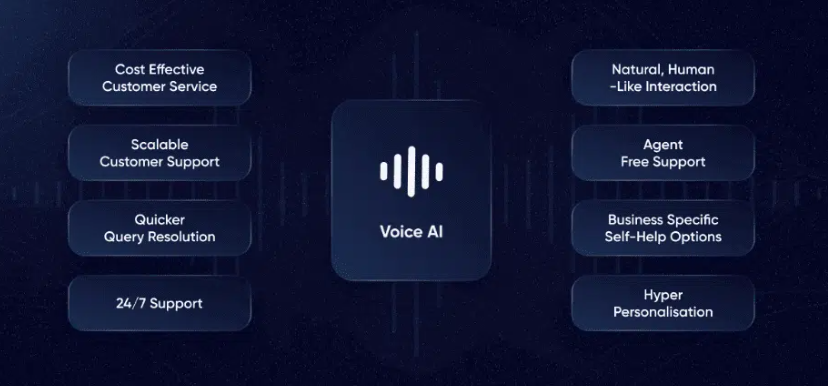
Voice AI improves engagement by changing the way users interact with the software. Instead of clicking, searching, or guessing, users simply ask the questions, and this element makes all the difference.
1. Enables natural, conversational interaction
Voice AI is like a friend. You can talk in the same way as you talk to your friend. There’s no need to remember some technical commands to talk with AI. Even a non-technical person can use the voice AI and get the work done.
For example, instead of training users on dashboards, let them ask: “What tasks are pending today?” or “Show me last week’s performance.” This reduces friction and increases daily usage of a particular platform.
2. Removes friction from complex workflows
Many SaaS platforms lose users because common tasks require too many steps. Voice AI shortens these workflows by responding instantly to intent.
If a user says, “Create a follow-up reminder for this lead,” voice AI can trigger the action without navigating multiple screens. In other words, it keeps users engaged rather than frustrated.
3. Improves feature discovery without overwhelming users
Advanced features often go unused simply because users don’t know they exist. Voice AI introduces them contextually, when they’re actually needed.
When a user asks about reports, voice AI can suggest, “Would you like to see a trend comparison or export this data?” It reduces the friction of searching for everything manually.
4. Turns passive dashboards into interactive experiences
Static dashboards require interpretation. Voice AI transforms them into interactive systems that explain insights instead of just displaying numbers.
A manager could ask, “Why did support response time increase this week?” and receive a summarized explanation. It makes insights easier to understand and act on.
5. Strengthens engagement in voice-driven support environments
In support environments built around phone and voice, AI doesn't just answer questions, it keeps the whole interaction tighter. Instead of agents toggling between screens to pull up customer history or searching knowledge bases mid-call, the AI handles that in the background - surfacing relevant context, suggesting responses, even handling routine questions entirely.
This keeps agents focused on the conversation itself rather than the systems around it. And when agents aren't fighting their tools, they stay sharper and more present with customers.
6. Supports users at the exact moment of need
Instead of leaving a person to search for documentation on how to use a platform or call the customer support, voice AI offers in-the-moment guidance.
If a user hesitates during setup, voice AI can step in with, “Would you like help completing this step?” It, thus, prevents drop-offs and frustration.
7. Encourages repeat usage through proactive guidance
Voice AI responds in the language that humans speak daily based on users' behavior, usage patterns, or missed opportunities.
If a feature hasn’t been used, voice AI can suggest, “Many teams use this to save time. Want a quick walkthrough?” This keeps engagement growing organically.
8. Builds confidence across all user roles
Not every user is technical. Voice AI lowers the learning curve and makes SaaS platforms accessible to sales, support, operations, and leadership alike.
Executives can ask for quick summaries, such as “What should I focus on today?” It makes a platform valuable at every level of an organization.
Measurable Engagement Gains Enabled by Voice AI
Higher daily and weekly active usage
Voice AI simplifies the process of understanding and using a platform. This simplification encourages users to come back more frequently and engage multiple times.
Faster onboarding and time-to-value
New users can complete tasks on a platform by asking questions and receiving proper guidance on how to do them. This increases speed and saves time that would otherwise go into learning how to use a platform.
Increased feature adoption across teams
Contextual voice prompts help users discover and use advanced features naturally. This improves the overall platform depth without overwhelming them.
Reduced support dependency and friction
Voice-driven assistance resolves common queries instantly. Therefore, the flow of queries to the support team is decreased. This keeps users productive and engaged.
Improved decision-making and user confidence
By converting data into conversational insights, voice AI enables users to quickly understand metrics and act with clarity, thereby driving consistent platform usage.
Real-World Examples of Voice AI Closing the Engagement Gap
1. Real-World Examples of Voice AI Closing the Engagement Gap
Problem: Customers were frustrated with clunky phone menus, long hold times, and having to repeat themselves every time they called back or switched channels. Small and mid-sized businesses struggled to deliver the kind of responsive, personalized service that keeps people coming back, and missed calls only made it worse.
Solution: Nextiva launched XBert, an AI receptionist that answers calls, texts, and chats using natural language.
Customers simply say what they need, like booking appointments, checking orders, or answering questions. If it can't resolve something directly, it routes to the right person with full conversation context. It syncs with calendars and CRMs, sends confirmations automatically, and works across channels so customers never have to start over.
Result: Businesses using XBert report a 40% increase in weekly leads, 25+ additional appointments booked per week, and up to 60% fewer missed calls. One franchise owner noted that every call now gets answered, while a dental office attributed thousands in new monthly revenue to the added bookings.
2. Salesforce Einstein Voice - CRM Platform Engagement
Problem: Sales reps and field service teams spent a lot of time on manual data entry and going through complex dashboards. This led to lower platform engagement and productivity.
Solution: Salesforce introduced Einstein Voice Assistant. This assistant helped users to talk to Salesforce to perform routine CRM transactions. Users can create or update customer records, receive personalized daily briefings, and explore dashboards simply by speaking through voice.
They can simply ask the assistant to do certain tasks like "Create a new lead record" or ask questions like "Einstein, tell me how my team is doing today," and get things done.
Result: This approach improved platform engagement by making interactions more natural and reducing friction for all teams.
3. CallHippo - AI Conversation Analytics for Platform Engagement
Problem: CallHippo was monitoring only a small percentage of random calls for business insights. It needed a scalable solution to identify gaps that led to revenue churn and improve agent performance within its platform.
Solution: CallHippo leveraged Enthu.AI to monitor 100% of its conversations and identify agent gaps.
Result: The solution resulted in a 20% reduction in revenue churn, a 13% improvement in new revenue conversion, and a 21% improvement in agent CSAT score. The AI-powered conversation intelligence helped surface churn and revenue opportunities that were immediately acted upon by supervisors.
This demonstrates how voice AI analytics within a SaaS platform can dramatically improve user (agent) engagement and platform effectiveness.
Bridge the Engagement Gap With Voice AI
B2B SaaS companies are leveraging voice AI to bridge gaps in engagement, increase onboarding, qualify leads more quickly, and ensure users interact with platforms more consistently.
The results are pretty clear, from automating appointment setting to improving follow-ups and lead qualification: more meaningful conversations, higher adoption, and stronger engagement across the board.
Are you planning to implement voice AI in your business and seeking expert guidance? Connect with SaaS Adviser. We help you discover, compare, and buy SaaS for your business while providing hands-on advice to build smarter, customer-first conversations that drive real impact.
Author's bio
Irov is a content marketing specialist, demand generation enthusiast, and team player who is currently working with 2xSaS. He helps B2B SaaS companies spread the word about their products through engaging content. When he is not working, he likes playing video games on his PS4.



Sign in to leave a comment.