
📊 Why the Food Delivery App Market Is Exploding Now
The food delivery industry is no longer a niche—it’s a key part of everyday life. Here are some stats that show just how fast it’s growing:
- The global food delivery app industry is expected to reach USD 213 billion by 2030. Business of Apps
- In 2024, the Food Delivery Apps Market was valued at around USD 162.75 billion, and it’s projected to hit USD 312.58 billion by 2032 at a CAGR of ~8.5%. Verified Market Research
- As of 2023, the global food delivery app market was already worth USD 99.1 billion, marking a 16.8% year-on-year growth. Business of Apps
These numbers tell a simple story: there’s huge appetite among consumers for faster, more convenient ways to get food delivered—and that means big opportunities for anyone thinking about Food Delivery App Development.
🔍 What Makes a Top-Tier Food Delivery App
Building a food delivery app that stands out means thinking beyond just “order food, deliver food.” To succeed, your app should combine usability, speed, trust, and smart technology. Key components include:
- User-friendly UI/UX: Easy browsing of menus, fast ordering, transparent fees and delivery time estimates.
- Real-time order tracking: Let customers track couriers, see live map updates, and receive notifications.
- Multiple user roles: Distinct but integrated interfaces and features for customers, restaurants, and delivery partners.
- Secure payments & wallet options: Supporting various payment methods, in-app wallets, cashless experiences.
- Ratings & Reviews + Trust Features: Feedback loops, restaurant verification, and safety checks.
- Efficient logistics & routing: Optimizing delivery routes, load management, delivery scheduling.
- Scalability & Infrastructure: Cloud support, microservices or modular architecture, caching, load balancing.
🚀 Key Trends & Growth Drivers
Understanding what’s pushing the market helps shape better strategy when planning Food Delivery App Development:
- Convenience demand: More consumers prefer to order food from apps rather than dine out, driven by busy lifestyles and urbanization.
- Smartphone & internet penetration: As more people get access to mobile internet (especially in emerging markets), demand surges.
- Cloud kitchens / ghost kitchens: Lighter infrastructure allows faster expansion and more restaurant partners without traditional brick-and-mortar costs.
- AI & personalization: Recommending popular dishes, estimating delivery times more precisely, offering dynamic pricing/promos.
- Contactless delivery & safety features: Important since the pandemic, still valued for hygiene and convenience.
- Sustainability: Eco packaging, efficient route planning, greener delivery options are increasingly part of customer decision factors.
⚙️ How to Develop a Food Delivery App: Step by Step
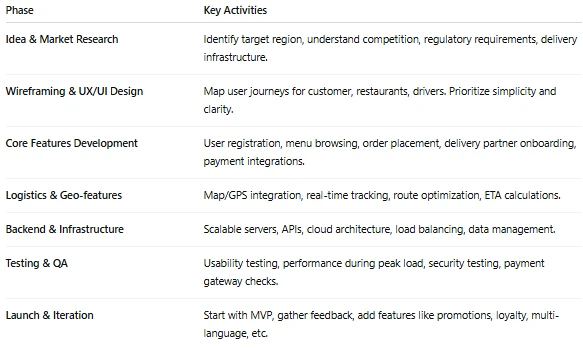
Here’s a high-level blueprint for Food Delivery App Development, from idea to launch:
How AQe Digital Helps You Build a Winning Food Delivery App
At AQe Digital, we understand both the technical and business complexities of building a food delivery app. Here’s how we help make your journey smoother, more successful, and faster:
- Customized Development: Tailored food delivery app solutions for your market with customer-focused features.
- End-to-End Technology Stack Expertise: From frontend UI/UX to backend infrastructure, API integrations, payment systems, and delivery partner module.
- Quality & Performance Focus: Ensuring app reliability, speed, security, and scalability so you can trust your product under load.
- Data & Analytics Integration: User metrics, order patterns, peak times, churn rates—for better decisions and optimization.
- Post-Launch Support & Growth Features: Loyalty programs, promos, restaurant partner tools, dashboards, and performance tuning.
🎯 Why Move Now
If you’re considering entering this space, here are strong reasons to do it now:
- Market size is large and still growing—expectations show industry numbers doubling or more in less than a decade. Business of Apps+1
- Consumer preferences are locked in for convenience and digital ordering.
- Technology has matured—real-time tracking, reliable GPS, secure payments are all standard expectations.
- Low barriers to entry, but high execution demands—if you get core features and UX right, you can stand out.
🔗 Dive Deeper
To get a full understanding of features, costs, development strategies, and what to prioritize in your own roadmap, check out our full guide:









Sign in to leave a comment.