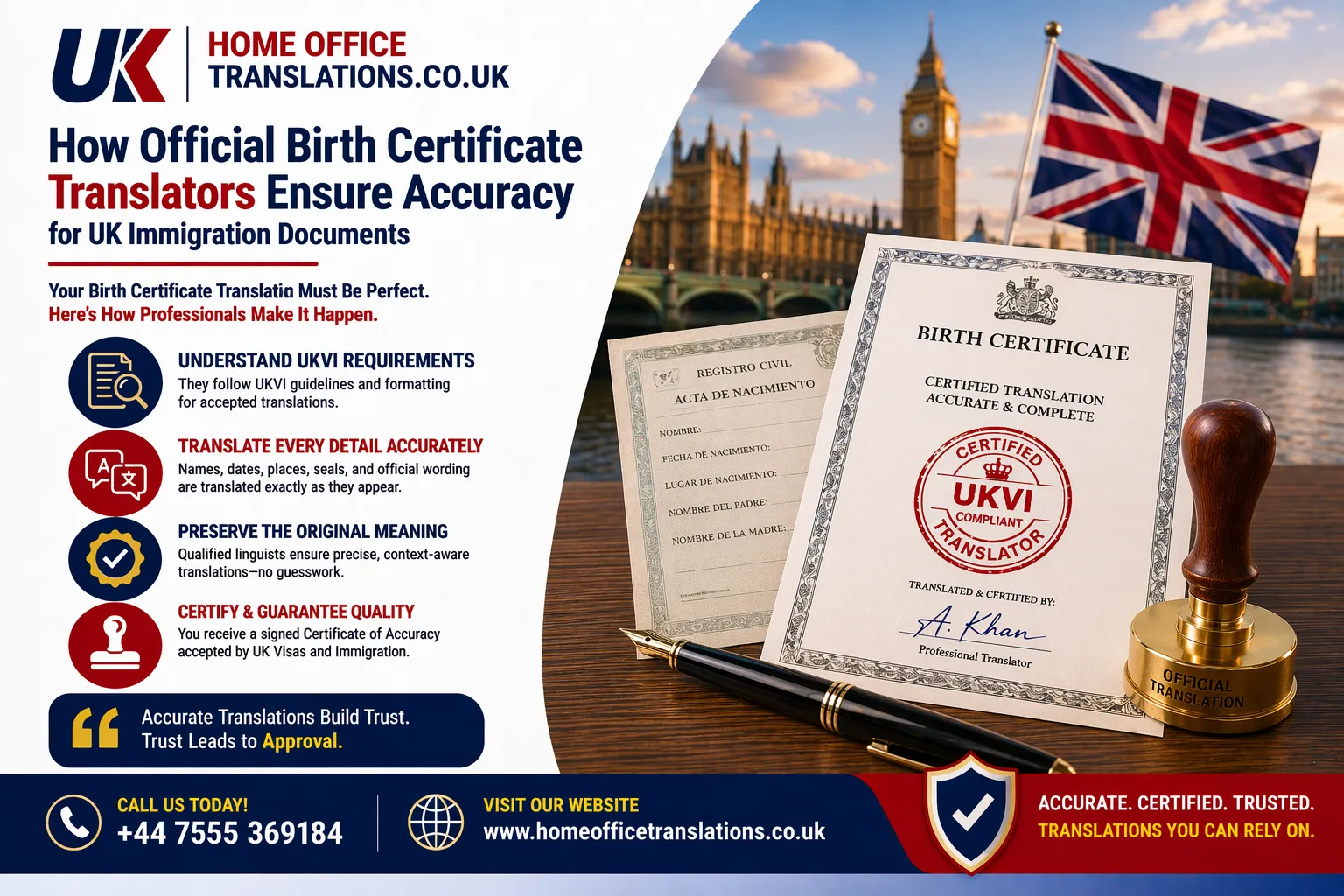

What makes a birth certificate translator "official"? The word is used loosely in this industry — it's not a regulated title in the UK. But in the context of immigration translation, what matters is a specific combination of professional qualifications, process rigour, and accountability.
Here's what the work actually involves.
Role of Official Translators in Maintaining Accuracy for Birth Certificate Translation
Birth certificates vary enormously by country. The format, the fields, the issuing authority, the script, the dating system — all of these differ across the documents that immigration translators work with. A birth certificate from Ethiopia uses a different calendar. One from Saudi Arabia uses Arabic script. One from Japan includes family registration information that has no direct UK equivalent. One from Nigeria may be handwritten by a local registrar.
Each of these requires the translator to bring specific knowledge to the work — not just linguistic competence, but familiarity with the administrative systems and document conventions of the originating country.
- Name romanisation: For documents from countries using non-Latin scripts, the translator must romanise names in a way that's both accurate to the source and consistent with how the name appears on the applicant's passport and other documents. This is a judgment call that requires both linguistic knowledge and awareness of the immigration context.
- Calendar conversion: For documents using non-Gregorian calendar systems, the translator must accurately convert dates to the Gregorian equivalent — and note the original calendar system used in the translation. Getting calendar conversion wrong creates a date of birth discrepancy that affects identity verification.
- Administrative vocabulary: Terms for registrar roles, issuing authority designations, district and province names — these need to be handled accurately, not approximated. A province name that's transliterated wrong may not match the same province name used in another document.
- Completeness: Every field, every stamp, every annotation. Birth certificate translators who understand immigration requirements know that every element matters — not just the headline information.
Official birth certificate translator professionals bring this combination of knowledge and discipline to every document they handle.
Common Errors Avoided by Professional Birth Certificate Translators in the UK
Inconsistent name rendering
Professionals cross-reference the passport before finalising name romanisation. Casual translators romanise based on their own judgement, which may not match the official document.
Calendar conversion errors
Professionals know which calendar system is used for official records in specific countries, and they apply the correct conversion. Casual translators may guess, or may not recognise that a date isn't in the Gregorian calendar.
Missing administrative fields
Professionals translate every field, including those that seem minor. Casual translators focus on the core information and treat the rest as optional.
Unchecked illegible sections
When text is genuinely illegible in the original, professionals note it specifically. Casual translators may skip it or make an educated guess — both of which are problematic.
Certification statement errors
Professionals know the required elements of a certification statement and include all of them. Casual translators may not know what a proper certification looks like.
How Certified Translators Ensure Compliance with UK Immigration Requirements
Certified translators working on immigration documents operate with a specific awareness that shapes every decision in the work. They know:
- That the translation will be read by a UKVI caseworker
- That the caseworker will cross-reference it against the original and against other documents in the file
- That inconsistencies will be flagged
- That incompleteness will be flagged
- That the certification statement will be checked for completeness
This awareness produces a different quality of work than translation for general purposes. It's not that immigration translation is technically harder — in many cases, it's not especially complex linguistically. It's that the stakes create a discipline that shapes every decision.
Also Read: Certified Visa Translation UK: Why Accuracy Is Critical for Immigration Approval
Tips to Choose Reliable Birth Certificate Translators for UK Applications
Commission from a service that specifically mentions immigration, UKVI, and Home Office documents as part of their core work.
Ask whether the translator has experience with birth certificates from the specific country of issue. Not all translators who cover a given language have experience with that country's administrative document conventions.
Request a sample of their certification statement format. Check it against the requirements.
Read immigration-specific reviews. Look for mentions of birth certificate translation specifically.
Allow time for review and correction if needed. Don't file the day you receive the translation.
The Small Document With Big Stakes
A birth certificate is a short document. But in a UK immigration application, it's doing significant work — establishing identity, proving parentage, confirming nationality at birth, providing a date of birth that will be cross-referenced against every other document in the file. The shortness of the document doesn't reduce the importance of getting it right.




















Sign in to leave a comment.