
The worst hair transplant outcomes are not caused by bad surgery. They are caused by good surgery that ignored the future.
Thousands of patients have received technically excellent procedures in their twenties, only to find themselves with transplanted hair framing a bald crown by their forties because nobody planned for continued hair loss.
If you are considering a Hair Transplant in Hyderabad, the most important conversation you will have is not about technique or graft count. It is about your hair loss trajectory and whether the surgeon in front of you is designing for where your hair will be in 20 years, not just where it is today.
Understanding Hair transplant cost in Hyderabad also means understanding that poorly planned procedures cost far more to correct than well-planned ones cost upfront.
Understanding Progressive Hair Loss and the Norwood Scale
Male pattern baldness is a progressive condition governed by genetics and dihydrotestosterone (DHT) sensitivity. The Norwood-Hamilton Scale classifies hair loss progression from Type I (no significant loss) through Type VII (only a horseshoe rim of donor hair remains).
The critical insight most patients miss is that at the time of their first hair transplant, they are usually somewhere between Type II and Type IV. Without medical intervention, many will progress to Type V, VI, or VII over the following decades.
A study in the Journal of Investigative Dermatology found that men who experience significant hair loss before age 30 have a 70 percent probability of progressing to advanced stages by age 50. This statistic transforms how a responsible surgeon should approach your procedure. Transplanting aggressively into areas that will remain stable is sound planning.
Transplanting into the mid-scalp without accounting for future crown exposure is creating a visual island of density surrounded by expanding baldness.
Donor Zone Capacity: The Finite Resource That Must Be Protected
Your donor zone, typically the back and sides of the scalp, contains follicles that are genetically resistant to DHT and will not miniaturize over time.
However, this zone has a finite number of follicular units, and once extracted, those follicles are gone permanently. Here is what determines sustainable donor management:
- Total donor capacity: Most patients have between 6,000 and 10,000 extractable grafts across their lifetime
- Safe harvest zone boundaries: Extracting outside the permanent zone risks using follicles that will eventually miniaturize, defeating the purpose of transplantation
- Density preservation: Removing more than 50 percent of follicles from any donor zone section creates visible thinning that looks worse than the original baldness
- Future session planning: Every graft used today is unavailable for future touch-ups, density improvements, or newly exposed areas
- Body hair consideration: Body hair from beard, chest, or arms can supplement scalp donor capacity in advanced cases, but caliber and texture differences limit their use in the hairline
A surgeon who exhausts your donor zone in session one has prioritized your immediate satisfaction over your long-term outcomes.
How Expert Surgeons Plan Around Future Hair Loss
A forward-thinking surgical plan follows this sequence:
- Predict progression: Using family history, current loss pattern, and DHT sensitivity markers, the surgeon maps the likely future extent of hair loss
- Establish a permanent hairline: The designed hairline should remain appropriate even if surrounding hair continues to thin significantly
- Prioritize coverage over density: A moderate density across a larger area looks more natural long-term than high density in a small area surrounded by future baldness
- Reserve donor grafts: Surgeons calculate total lifetime donor availability and allocate strategically across likely future sessions
- Prescribe medical support: Finasteride or minoxidil prescribed alongside surgery slows progression, extending the window before additional procedures are needed
- Stage large cases: Patients with extensive current loss may benefit from two planned sessions rather than one depleting session
This planning is invisible in before-and-after photos but determines whether results look excellent at year 1 and year 15.
Why Ethical Surgeons Sometimes Say Less Than You Want
An experienced surgeon may recommend fewer grafts than you request, a more conservative hairline than you designed, or a staged approach across years rather than maximum coverage immediately.
These recommendations are not limitations of skill. They are evidence of it.
The pressure patients place on surgeons to deliver ambitious single-session results is real, and some clinics capitulate to that pressure at the patient's long-term expense.
A surgeon who agrees to transplant 4,500 grafts into a 25-year-old with Type III loss and a family history of Type VII progression is either uninformed or prioritizing revenue over outcomes.
Ask your surgeon to show you what their proposed design will look like if you progress two Norwood stages beyond your current classification. If they cannot answer this question or do not take it seriously, find a different provider regardless of donor zone quality or Hair transplant cost in Hyderabad comparisons.
Myths About Hair Transplant Planning and Future Loss
Myth 1: A hair transplant stops hair loss.
Transplanted follicles are permanent because they are DHT-resistant. However, surrounding native hair continues to miniaturize without medical treatment. Future loss around transplanted areas is virtually guaranteed without intervention.
Myth 2: Young patients should transplant aggressively to maximize results.
The opposite is true. Young patients have more future hair loss ahead of them and must be most conservative with donor zone allocation and hairline placement. Aggressive early procedures create the worst long-term outcomes.
Myth 3: A second session is always possible.
Future sessions require sufficient residual donor density. Patients whose donor zones were over-harvested in session one may have no viable options for future coverage.
Myth 4: Hair transplant cost in Hyderabad is the primary planning variable.
Cost is one factor. Donor preservation strategy, progression planning, and hairline design conservatism are more important planning variables that affect results for decades.
FAQ
Q1: At what age is it safe to have a hair transplant?
A: Most experienced surgeons recommend waiting until at least 25 to 30 years of age, when hair loss patterns are more predictable. Operating on teenagers or very young adults risks designing a hairline that becomes inappropriate as loss advances.
Q2: Should I take finasteride before or after my hair transplant?
A: Many surgeons recommend establishing a stable baseline on finasteride for 6 to 12 months before surgery to understand how much native hair can be preserved. This informs a more accurate surgical plan.
Q3: How many hair transplant sessions can most patients realistically have?
A: Most patients with average donor density can safely undergo two to three sessions over their lifetime. Beyond that, donor depletion typically limits further extraction without compromising donor zone appearance.
Q4: What happens if I need coverage in an area that was not transplanted initially?
A: If donor reserves were properly managed, a second session can address newly exposed areas. If donor zones were depleted, options are limited to scalp micropigmentation or hairpieces.
Q5: Does my family history of baldness predict my progression?
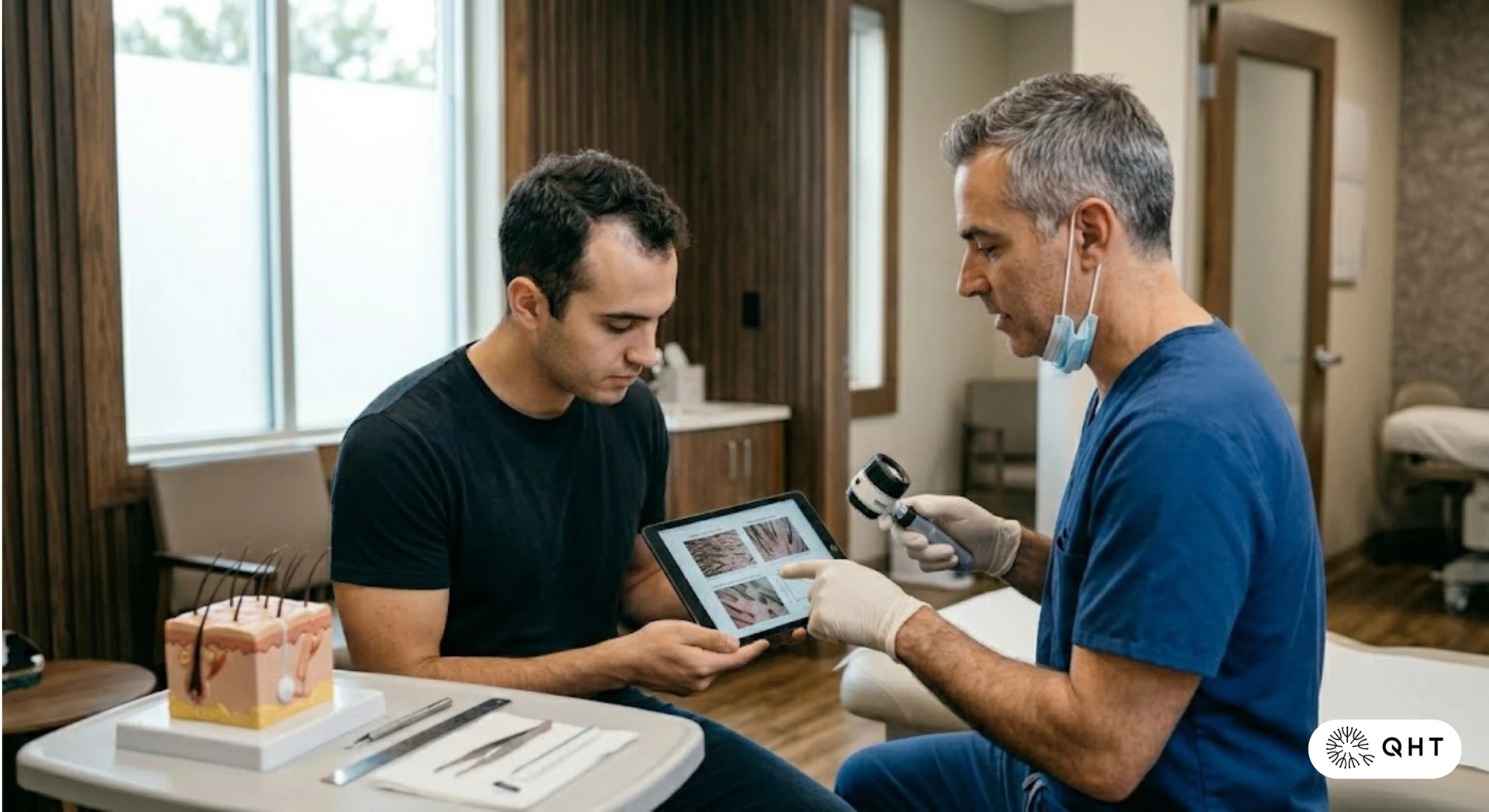
A: Family history on both maternal and paternal sides provides useful directional information, but it is not perfectly predictive. Trichoscopy and DHT sensitivity testing give more clinically reliable data for individual planning.
Conclusion
A hair transplant is not a single event. It is the first decision in a decades-long relationship with your hair. The clinics that understand this design every procedure with your 50-year-old self in mind, not just your post-procedure photos.
When evaluating a Hair Transplant in Hyderabad, ask every surgeon how they plan around future hair loss before agreeing to any graft count or design.
When comparing Hair transplant cost in Hyderabad, recognize that a thoughtfully staged, donor-preserving approach protects your investment far better than a single aggressive session.
For surgeons who plan with your future in mind, visit QHT Clinic and schedule your long-term planning consultation today.




























Sign in to leave a comment.