
According to industry data from the Dodge Construction Network, up to 30% of the initial cost of a typical construction project is consumed by rework. The primary culprit? Inaccurate design documentation and poor on-site coordination. In an era where material costs are volatile and project margins are razor-thin, relying on two-dimensional assumptions is no longer just a technical oversight, it is an expensive financial liability.
The global Architecture, Engineering, and Construction (AEC) sector is undergoing a profound digital transformation. From strict government mandates in the UK to rapid digital adoption across North America and Asia-Pacific, the push for absolute data integrity is reshaping how we build. Building Information Modeling (BIM) has evolved from a novel visualization tool into the foundational database for the entire asset lifecycle. However, adopting the software is only the first step. The true return on investment (ROI) is unlocked through a relentless commitment to highly accurate, data-rich models that serve as a single source of truth—effectively eliminating the spatial ambiguities that have historically delayed project delivery.
The Financial Toll of Fragmented Documentation
Historically, project delivery operated in strict disciplinary silos. Architectural intents, structural frameworks, and MEP (Mechanical, Electrical, and Plumbing) systems were developed with minimal real-time cross-referencing. This disconnected approach routinely led to severe on-site clashes, triggering a cascade of Requests for Information (RFIs), change orders, and costly schedule overruns.
When field teams encounter physical conflicts during the build phase, on-the-fly problem-solving rarely aligns with optimal engineering standards. The shift from fragmented documentation to intelligent, federated digital models fundamentally redistributes this risk.
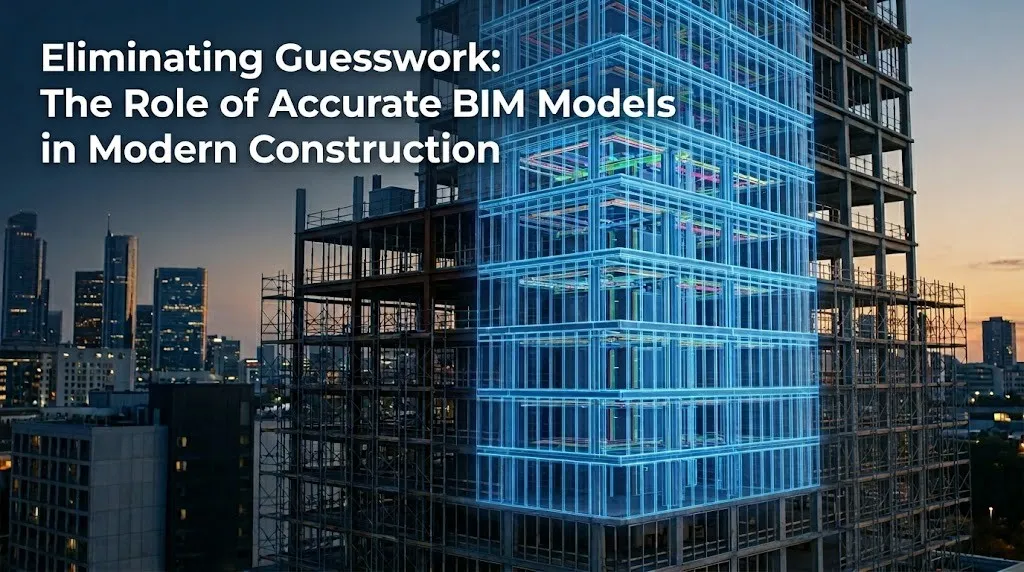
By investing in comprehensive 3D BIM Services, stakeholders transition from reactive problem-solving to proactive clash resolution. Instead of discovering a ventilation duct intersecting a primary structural steel beam on the active job site, engineering teams identify and resolve the conflict virtually. The intrinsic value lies in predictive certainty: ensuring that what is engineered in the digital environment is exactly what is fabricated and constructed.
Moving Beyond Visualization: The Rigor of LOD Standardization
Accuracy in digital modeling is not subjective; it is strictly defined by the Level of Development (LOD) framework. A common misconception among emerging AEC firms is that a visually appealing 3D model equates to a constructible one. The distinction between a generic spatial representation and a highly accurate virtual prototype is vast.
- LOD 300 (Precise Geometry): Elements are modeled with specific assemblies, precise quantities, sizes, shapes, and locations. This is the critical threshold where accurate documentation replaces assumptions.
- LOD 400 (Fabrication Ready): Models incorporate the meticulous detailing and assembly information necessary for physical construction. For example, in structural detailing, this precision directly dictates the accuracy of CNC machine outputs in the fabrication shop.
- LOD 500 (Operational Digital Twin): Field-verified "as-built" conditions that form a reliable database for long-term facility management.
Deploying meticulous 3D BIM Modeling Services focused on higher LOD standards ensures that every dimension and material specification is rigorously verified. A structural model must remain technically distinct and perfectly coordinated with mechanical routing—there is zero room for approximation.
Industry Insight: For a deeper dive into how these collaborative workflows are actively reshaping project delivery across various disciplines, explore this comprehensive guide. To gain a unique and more informative view, check out this full blog on the application of BIM modelling services in construction technology.
Bridging the Gap: Design Intent vs. Execution Reality
One of the most transformative impacts of accurate virtual modeling is the seamless bridge it creates between conceptual design and physical execution. The traditional friction between architects designing for aesthetic intent and engineers solving for physical reality is largely mitigated when both operate within a unified digital ecosystem.
This collaborative environment relies heavily on standardized BIM Modeling Services to maintain absolute data continuity. When disciplines are federated into a single, clash-free model, the entire supply chain benefits:
- Fabricators receive exact material takeoffs, drastically reducing material waste.
- Logistics Teams can optimize delivery schedules based on 4D (time) modeling, ensuring prefabricated components arrive exactly when needed.
- General Contractors can sequence construction phases with mathematical precision, reducing on-site downtime.
Strategic Implementation and the Role of Expertise
Despite the proven advantages, achieving consistently accurate models remains a formidable challenge. The barriers are rarely about software licenses; they are deeply rooted in human capital, process standardization, and change management. Developing a team capable of executing complex LOD 400 documentation requires stringent quality assurance protocols.
This is where strategic partnerships become invaluable. Navigating the transition to advanced digital environments often requires the guidance of experienced BIM Consulting Services. These subject matter experts assist AEC firms in establishing robust BIM Execution Plans (BEP) and implementing rigorous quality control audits. They don't just help build a one-off model; they engineer a predictable, repeatable digital workflow that aligns with global standards like ISO 19650.
The Long-Term Asset: From Construction to Facility Management
The financial narrative surrounding high-accuracy modeling often focuses heavily on the construction phase. However, the longest and most expensive phase of a building's lifecycle is its operational phase. An accurate, data-rich model seamlessly transitions from a construction deliverable into a robust facility management tool.
When facility managers inherit a precise digital twin, ongoing maintenance is revolutionized. Every piece of equipment, its maintenance schedule, and its precise physical location is cataloged logically. To achieve this elite level of lifecycle intelligence, partnering with a provider for comprehensive BIM Services ensures that the final digital deliverables are tailored not just for the contractors, but for the end-users who will operate the asset for decades.
Actionable Takeaways for AEC Leaders
Transitioning to a guesswork-free construction model requires deliberate, strategic action. Implement these steps to safeguard your project margins:
- Standardize LOD Requirements Early: Before schematic design commences, explicitly define the Level of Development required for each specific discipline at every project milestone within your formal BEP.
- Prioritize Routine Spatial Audits: Do not wait until the final documentation phase to run spatial coordination checks. Implement bi-weekly federated model reviews to catch clashes while they are still inexpensive digital fixes.
- Audit Past Documentation Failures: Evaluate your last three completed projects. If disjointed discipline coordination was a recurring theme, upgrade your modeling standards immediately.
- Maintain Disciplinary Integrity: Ensure that workflows respect the technical boundaries between disciplines (e.g., keeping structural detailing distinct from MEP routing) to ensure downstream fabrication accuracy.
The Future of Precision in Construction
The era of relying on best guesses and on-site improvisations is rapidly drawing to a close. As the AEC industry continues its digital transformation—integrating artificial intelligence and automated clash resolution—the foundational requirement will always remain the same: uncompromising accuracy in the underlying data.
Accurate virtual models are no longer an optional add-on; they are the critical, load-bearing infrastructure of modern project delivery. By committing to precise documentation today, we forge a more resilient, efficient, and profitable industry for tomorrow.


























Sign in to leave a comment.