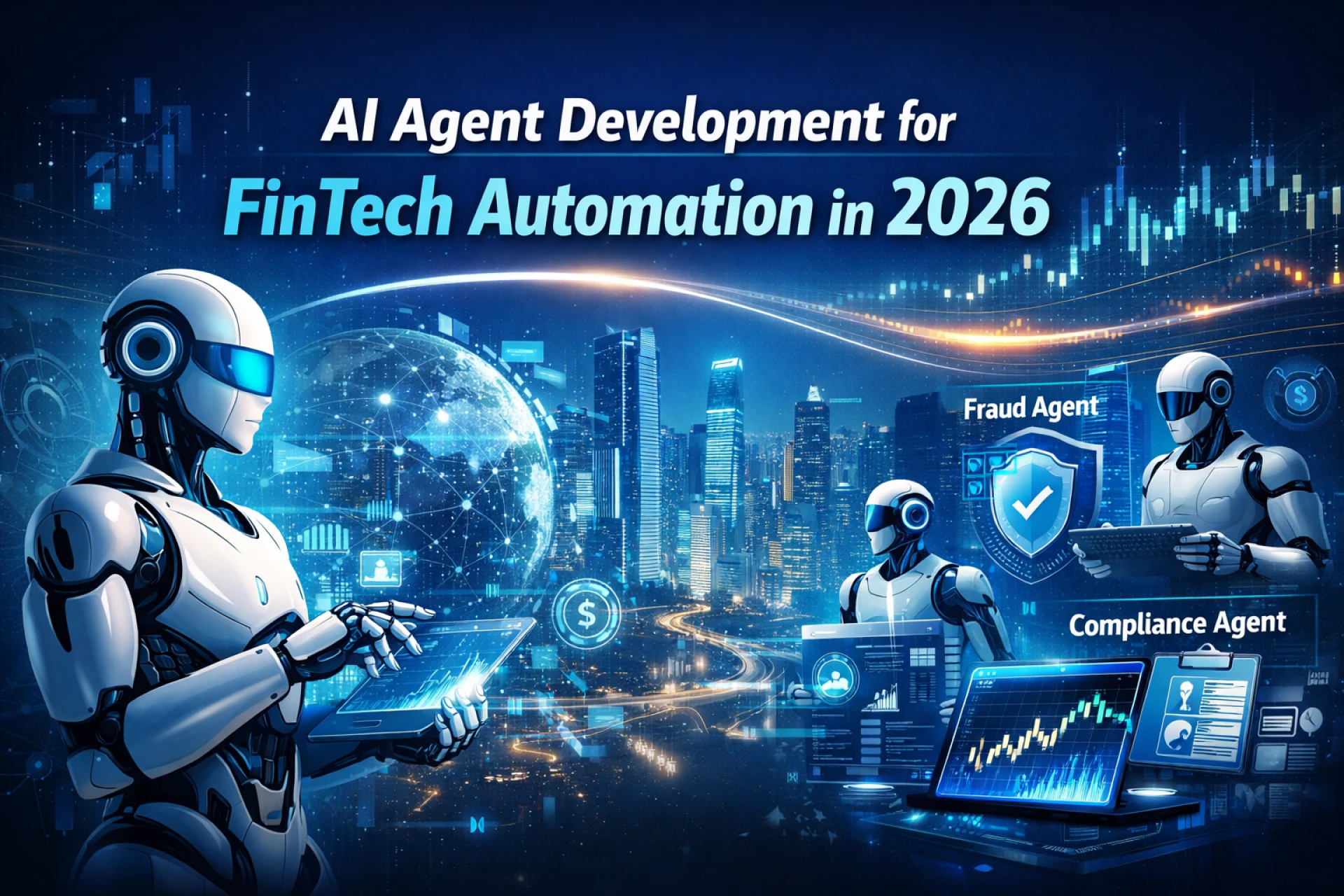

At 2:14 a.m., a coordinated fraud attempt hits a digital banking platform. Thousands of micro-transactions are launched across borders, devices, and accounts in seconds. In the past, this would have triggered alerts, queued tickets, and human reviews that arrived too late. In 2026, the response is different. A network of autonomous AI agents detects abnormal behavior, validates identities, cross-checks regulatory rules, reroutes payments, and documents every action for audit—before a human even wakes up.
This is not traditional automation. It is Agentic AI, and it is redefining AI agent development for FinTech.
For over a decade, FinTech automation relied on rules engines and Robotic Process Automation (RPA). While effective for repetitive tasks, RPA breaks down in dynamic, high-risk environments. Agentic AI represents the next evolution—systems that can reason, act, collaborate, and learn continuously. As FinTech automation in 2026 accelerates, agentic architectures are becoming a competitive necessity rather than an experimental upgrade.
The Anatomy of a FinTech AI Agent
A FinTech AI agent is not a conversational interface layered on top of workflows. It is an autonomous decision-making entity built on a Think–Act–Learn loop. The agent first reasons over context using large language models, structured data, and historical signals. It then takes action by invoking tools such as payment APIs, risk engines, or compliance systems. Finally, it learns from outcomes through feedback loops and human-in-the-loop governance.
This cognitive automation enables agents to operate in environments where uncertainty, regulation, and real-time risk intersect—core characteristics of financial services.
The Modern Tech Stack Powering Agentic AI
Agentic AI in financial services is enabled by a layered architecture. Large Language Models provide reasoning and contextual understanding. Retrieval-Augmented Generation ensures decisions are grounded in internal policies, regulatory documents, and transaction histories. Tool-use allows agents to interact with external systems through APIs, from core banking platforms to fraud detection engines.
For FinTechs, this API-first architecture is critical. It allows AI agents to plug into existing ecosystems without replacing mission-critical infrastructure, preserving stability while enabling intelligence.
Multi-Agent Orchestration in Banking
The real breakthrough comes from multi-agent orchestration. Instead of a single monolithic system, FinTech platforms deploy specialized agents that collaborate. A Fraud Detection Agent monitors behavioral anomalies in real time. A Compliance Agent validates actions against AML and KYC rules. A Risk Modeling Agent simulates downstream exposure. A Customer Support Agent communicates outcomes transparently to users.
These agents coordinate through shared memory and orchestration layers, enabling faster and more accurate decisions than any standalone system. This approach is rapidly becoming the foundation of autonomous AI agents for finance.
Key Use Cases Transforming FinTech in 2026
Hyper-Personalized Wealth Management
In 2026, wealth management is shifting from static portfolios to adaptive financial ecosystems. AI agents act as “financial twins,” continuously aligning investment strategies with market conditions, life events, and risk tolerance. By combining real-time risk modeling with hyper-personalization in banking, these agents deliver advice that evolves daily rather than quarterly.
This level of personalization was impossible with human-only advisory models and is now a defining differentiator for digital-first financial institutions.
Autonomous Compliance and RegTech
Compliance has traditionally been a bottleneck, with AML and KYC checks taking up to 48 hours. Agentic AI changes this paradigm. Autonomous agents perform continuous identity verification, transaction monitoring, and regulatory validation in real time. Automated KYC compliance reduces onboarding friction while maintaining audit-ready documentation.
With human-in-the-loop governance, compliance teams oversee policies and exceptions rather than manual reviews, improving both speed and regulatory confidence.
Next-Generation Underwriting
Underwriting is being transformed by generative AI for underwriting combined with explainable AI. Agentic systems evaluate alternative data sources, behavioral signals, and macroeconomic indicators to approve or reject loans in minutes. More importantly, they generate transparent explanations for every decision, aligning with regulatory requirements and customer trust.
This shift enables inclusive finance while reducing default risk through continuous post-approval monitoring.
Intelligent Payment Orchestration
Cross-border payments remain costly and slow due to fragmented networks. In 2026, AI agents manage intelligent payment orchestration, dynamically selecting routes based on fees, settlement speed, and risk exposure. When anomalies arise, agents reroute transactions instantly, minimizing failure rates and operational losses.
For global FinTech platforms, this capability directly impacts margins and customer satisfaction.
Strategic Development: How to Build FinTech Agents
Data Readiness as a Competitive Asset
Agentic AI is only as effective as the data it consumes. Clean, governed, and well-labeled data is the fuel for autonomous financial workflows. FinTech organizations must invest in unified data layers that combine transactional data, customer profiles, and regulatory knowledge with strict access controls.
Without strong data foundations, even the most advanced AI agent development efforts will underperform.
Governance by Design
In financial services, autonomy without accountability is unacceptable. Governance must be embedded at the architectural level. This includes policy constraints, decision logs, explainability layers, and escalation paths to human reviewers. Human-in-the-loop governance ensures agents operate within defined risk boundaries while retaining the flexibility to adapt.
This approach satisfies regulators while enabling innovation at scale.
Integration with Legacy Systems
Most financial institutions operate on legacy core banking systems. Agentic AI does not require a full replacement. Instead, agents connect through thin cores and middleware layers, enabling incremental modernization. This integration-first strategy accelerates time-to-value while reducing transformation risk.
The ROI of FinTech Autonomy
By 2026, organizations deploying agentic AI report measurable returns. Internal benchmarks show up to 45% reduction in operational costs, 60% faster fraud response times, and 35% improvement in customer satisfaction scores. Compliance processing times drop from days to minutes, while underwriting approval cycles shrink by over 70%.
These gains are not theoretical. They reflect the compounding impact of autonomous decision-making across high-volume financial workflows. For FinTech leaders, AI agent development is increasingly tied directly to profitability and scalability.
The Future Outlook: The Orchestrated Workforce
The future of FinTech is not human versus AI, but human plus AI. Agentic systems are evolving into digital teammates that handle complexity, speed, and scale, while humans focus on strategy, ethics, and innovation. This orchestrated workforce model redefines productivity across financial services.
As agentic AI matures, FinTech platforms that embrace autonomy early will set the standards others must follow.
Conclusion: Agentic AI as a Competitive Necessity
Agentic AI is no longer an emerging concept it is the backbone of FinTech automation in 2026. From fraud prevention and compliance to underwriting and payments, autonomous AI agents are reshaping how financial services operate.
For FinTech leaders, the question is no longer whether to invest in AI agent development, but how quickly they can build, govern, and scale it. In an industry defined by speed, trust, and resilience, agentic AI is becoming the ultimate competitive advantage.
Sign in to leave a comment.