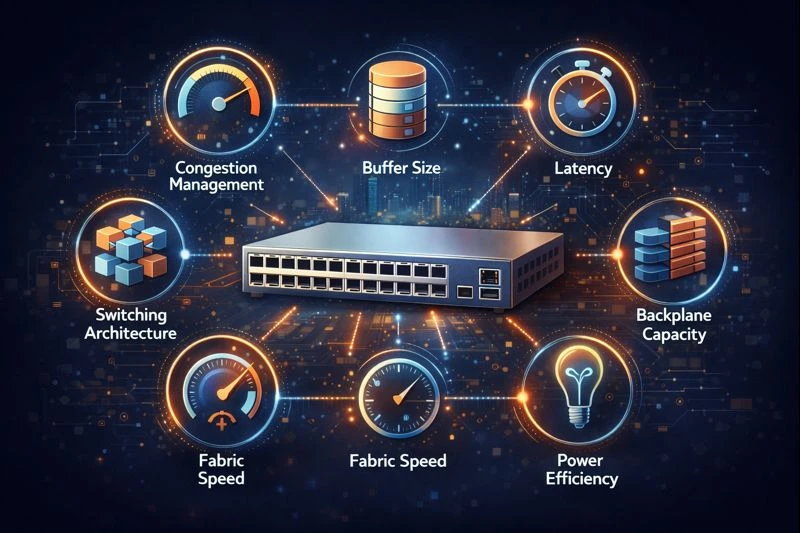

Network performance depends heavily on the choices you make about switching fabric architecture. Your Ethernet switch acts as the central nervous system of your network infrastructure. The switching fabric determines how fast data packets move between ports. The next-generation networks require not only very high speeds but also very low latency. Also, businesses want switches that can process vast quantities of data without lagging performance.
No matter which switching fabric technology you choose, it is decidedly the most direct measurement of your network capacity and assurance. Understanding these seven critical fabric choices helps you build faster and more efficient networks.
Let's talk in detail!
1. Shared Memory Architecture Delivers Flexible Port Management
Shared memory switching fabric uses a common memory pool that all ports can access. This design offers exceptional flexibility in handling traffic patterns. It assists your Ethernet switches in dynamically allocating buffer space where it is needed most, preventing congestion on busy ports while avoiding wasted memory on idle ones.
The switch allocates memory dynamically based on current port requirements. Ports experiencing heavy traffic get more memory resources automatically. Ports with lighter loads use less memory space.
Benefits of Dynamic Resource Allocation
This architecture prevents memory waste across the switching infrastructure. Your network adapts to changing traffic conditions in real time.
Key advantages include:
- Reduced packet loss during traffic bursts.
- Better handling of asymmetric traffic flows.
- Efficient use of memory resources.
- Lower hardware costs for similar performance levels.
2. Crossbar Switching Fabric Powers High-Speed Data Centers
Crossbar architecture creates dedicated paths between input and output ports. This design eliminates contention and delivers predictable performance.
Each input port connects to every output port through individual switching points. The fabric establishes temporary connections as packets arrive. These connections break down once the data transfer completes.
Why Data Centers Choose Crossbar Design
Data centers require consistent low-latency performance across all connections. Crossbar switching provides the deterministic behavior these environments demand.
Performance characteristics include:
- Non-blocking architecture for maximum throughput.
- Minimal latency variation between packets.
- Scalable design supporting hundreds of ports.
As per the forecast, the global Ethernet switches market is going to exceed $68.04 billion by 2032; therefore, the focus on performance-oriented switch design will be paramount.
3. Mesh Topology Creates Redundant Switching Paths
Mesh switching fabric builds multiple interconnected paths throughout the switch. This redundancy improves both reliability and performance.
The fabric contains numerous switching elements arranged in a mesh pattern. Traffic can flow through various routes to reach its destination. The switch selects optimal paths based on current network conditions.
Network resilience increases dramatically with mesh architectures:
- Automatic failover when paths become congested.
- Load balancing across available routes.
- Continued operation despite component failures.
- Higher aggregate bandwidth than single-path designs.
4. Time Division Multiplexing Optimizes Port Utilization
TDM switching fabric divides time into fixed slots for different ports. Each port gets guaranteed access to the fabric during its assigned time window.
The switch cycles through all ports in a predetermined sequence. Ports transmit data only during their allocated time slots. This approach ensures fair access to switching resources.
Predictable Performance Through Time Scheduling
TDM eliminates the unpredictability common in contention-based systems. Your applications get consistent performance regardless of network load.
Implementation benefits include:
- Zero packet collisions within the fabric.
- Deterministic latency for real-time applications.
- Simple quality of service implementation.
- Efficient handling of voice and video traffic.
Industrial control systems and telecommunications networks favor TDM switching. The guaranteed timing characteristics match their strict requirements.
5. Space Division Switching Enables Massive Scalability
Space division fabric creates physically separate paths for simultaneous connections. Multiple conversations occur in parallel without interference.
The architecture uses dedicated hardware paths for each active connection. Switches can handle numerous simultaneous data transfers. Each connection maintains full bandwidth without sharing resources.
Scalability advantages make this approach popular:
- Support for thousands of concurrent connections.
- Linear performance scaling as ports increase.
- No degradation during high utilization periods.
- Ideal for high-density switching applications.
6. Virtual Output Queuing Eliminates Head-of-Line Blocking
VOQ switching fabric maintains separate queues for each output port. This design prevents a single congested port from blocking traffic to other destinations.
Traditional switches suffer when one output port becomes busy. Packets destined for other ports get stuck behind the blocked traffic.
How Separate Queues Improve Throughput
Each input port has its own distinct queues for all possible output destinations. The switch treats the queues separately according to the availability of the output port.
Performance improvements include:
- Maximum fabric utilization under all conditions.
- Elimination of head-of-line blocking effects.
- Better fairness across competing flows.
- Higher overall network throughput.
7. Hybrid Architectures Combine Multiple Fabric Technologies
Modern switches often blend different switching fabric approaches. Hybrid designs capture the strengths of multiple architectures.
Manufacturers combine crossbar elements with shared memory systems. Others integrate mesh topology with virtual output queuing. These combinations deliver superior performance across diverse workloads.
Hybrid implementations offer compelling advantages:
- Varied traffic performance optimization.
- Better performance measures of the cost ratios.
- Approach to the overall latency throughout equilibrium.
Read Also: 5 Cloud Computing Practices That Improve Distributed Systems
Conclusion
Switching fabric architecture forms the foundation of Ethernet switches performance. The selection made by you will have an impact on the effectiveness of data transfer in your network infrastructure. Every type of fabric has unique strengths suited to particular applications and settings.
Hybrid methods combine the finest characteristics of several technologies. Knowing these seven fabric options allows you to choose switches that really fit your requirements. A proper switching fabric elevates your network from good to great.
Take time to evaluate your specific requirements before making this critical infrastructure decision. Your network performance depends on choosing the switching fabric that aligns with your operational goals.











Sign in to leave a comment.